Why Local Links Are Different
Link building for local SEO works on fundamentally different logic than general SEO. You are not competing for global authority or trying to outrank national brands. You are trying to show Google that your business is a real, active part of a specific community. That shifts everything about which links actually matter.
The links that move the needle are not from big national publications. They are from local news outlets, community organizations, neighborhood associations, and institutions people in your city actually recognize and trust.
Whitespark's 2026 Local Search Ranking Factors report, compiled from 47 top local SEO experts, confirmed this direction clearly: local visibility today is built on engagement, credibility, and genuine community connection. Quality and authority of inbound links to your domain remains one of the top local organic ranking factors, but the emphasis is firmly on local relevance, not volume. Ten strong local links will outperform a hundred generic ones every time.
There is also a newer wrinkle worth knowing. AI-powered search results, including Google's AI Overviews and tools like ChatGPT, now factor in how well-cited a business is across trustworthy local sources. Businesses with solid local link profiles are more likely to surface in AI-generated answers for geo-specific queries. It is one more reason local link building is not a tactic you can skip in 2026.
Tactics That Tend to Work
Local Sponsorships and Community Involvement
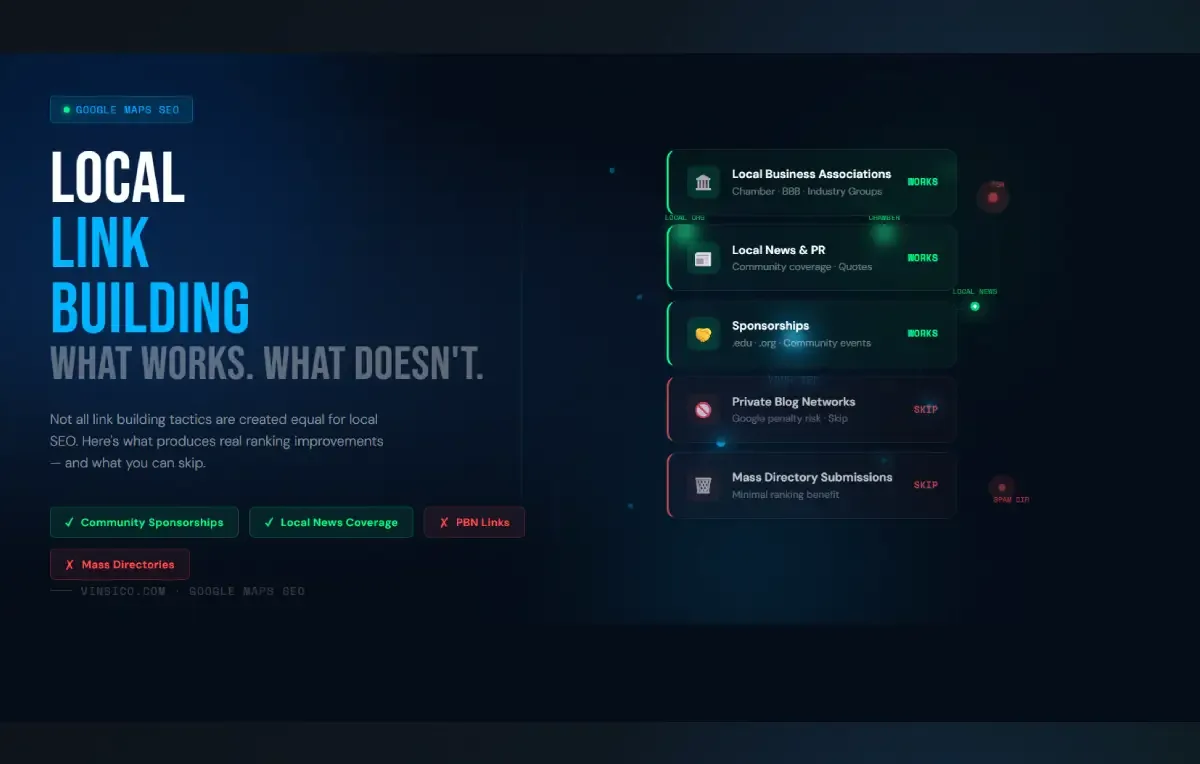
Sponsoring local events is one of the most reliable ways to earn genuine local links. Youth sports leagues, charity 5K runs, school fundraisers, local arts festivals and community organizations regularly publish sponsor pages with links back to supporter websites. These links tend to come from .edu, .org, or city government domains, and they carry real weight because they are genuinely editorial and locally relevant.
The one rule that matters here: the sponsorship should make geographic sense. A plumber in Denver sponsoring a Denver school fair is a natural connection. The same plumber sponsoring something in Phoenix, just to get a link, is not. Google is good at recognizing when sponsorships are authentic versus when they are link acquisition dressed up as community involvement.
To find opportunities, search Google for "your city" + "sponsors" + "inurl:sponsors" or "your city" + "community partners" + site:.org. You will find organizations actively looking for support, and many of them have sponsor listing pages already set up.
Local Business Associations
Your local Chamber of Commerce is probably the single highest-value local link available to most businesses. Chamber websites tend to carry strong domain authority, they manually vet member applications, and Google treats them as a trust signal that validates your business as a legitimate, locally-operating entity. If your Chamber maintains a member directory, get listed.
Beyond the Chamber, the Better Business Bureau (BBB) is worth joining for reasons beyond the link itself. Google's support team reportedly uses BBB listings to verify business existence during Google Business Profile reinstatements and suspensions. If your GBP listing ever gets flagged, having a BBB profile can significantly speed up recovery. Local industry associations, trade groups, and professional bodies in your sector are also worth pursuing since they combine local relevance with topical authority.
Local News and PR Coverage
A mention in your city's newspaper or a quote in a local news story generates some of the most authoritative local links available. Local journalists are regularly looking for knowledgeable sources on community issues, and many smaller outlets are understaffed and genuinely appreciate outreach from local business owners who can add expert perspective.
The most effective angles tend to be data-driven stories (share something you have observed about your local market), a genuine community contribution, or an informed opinion on a local development. Pitching yourself as a go-to source for your niche builds a relationship over time, not just a one-time mention.
Guest Posts on Hyper-Local Blogs and Neighborhood Sites
City-specific parenting blogs, neighborhood community sites, local event guides and city lifestyle publications often accept guest contributions from local experts. A post about seasonal home maintenance tips on your city's neighborhood blog sends a stronger local relevance signal than the same content published on a national home improvement site.
The key word is hyper-local. It is the geographic specificity that makes the link valuable, not the size of the audience.
Tactics You Can Skip
Mass Directory Submissions
Blasting your business information to hundreds of generic directories was standard practice a decade ago. Today it adds almost nothing. Focus your energy on the directories that actually matter: Google Business Profile, Bing Places, Apple Maps, Yelp, Facebook, BBB, and a small number of industry-specific platforms relevant to your niche. Everything beyond that is diminishing returns at best.
Private Blog Networks (PBNs)
PBN links violate Google's guidelines and the risk profile has gotten worse, not better, over time. Google's ability to detect manipulated link patterns has improved substantially. Even if a PBN produces a short-term bump in rankings, the exposure risk is significant and the gains rarely last. It is not worth it.
Reciprocal Link Exchanges
Informal link swaps between local businesses can feel harmless and occasionally a natural partnership does justify mutual linking. The problem is that at any scale, reciprocal exchanges create link patterns that look unnatural to Google's algorithms. They can also create NAP inconsistencies if the other site lists your business information incorrectly, which introduces a separate problem for your local rankings.
The Bottom Line
The best local link building strategy and the best community strategy are basically the same thing. Sponsor local events, join local organizations, build genuine relationships with journalists in your area, and show up consistently as a real participant in your community. These activities generate links naturally, and the trust signals they create extend well beyond what any purely technical SEO tactic can replicate. In 2026, with AI search results adding another layer on top of traditional local packs, that kind of authentic local footprint is more valuable than it has ever been.