Google is now testing a feature inside Google Business Profile that generates AI-drafted replies to customer reviews. Click a button, get a response, publish it. Simple.
And the first question every smart business owner should be asking is: if Google hands every business the same AI reply tool, and everyone starts using it, does anyone actually gain a ranking advantage? If the playing field is level, what is the point?
It is a fair question. On the surface, the logic seems airtight. If everyone replies to reviews using the same Google AI, nobody stands out. The feature cancels itself out. Ranking benefit drops to zero.
That logic sounds clean. But it falls apart at multiple levels when you look at how local search actually works, how business owners actually behave, and what Google's algorithm actually measures. Let us walk through it.
Most Businesses Will Not Use It, Even When It Is Free
This is the single most important point in this entire article, and it is the one that most analysis will skip over.
Google has been giving local businesses free tools for over a decade. Google Business Profile itself is free. Google Posts is free. Adding photos, updating hours, responding to reviews manually, all free. It costs nothing and takes minutes.
And yet the adoption numbers are brutal.
According to a Medium analysis of GBP data, 46% of local businesses have not even claimed their Google Business Profile. Nearly half of all local businesses in the world have not taken the first, most basic step of saying "yes, this is my business" on the platform that controls 73% of all online reviews globally.
Birdeye's State of Google Business Profile 2025 report found that fully populated, verified profiles appear 80% more often in search results and generate 4 times more website visits, 12% more calls, and 10% more direction requests than incomplete or unverified listings. Complete profiles get 7 times more clicks than incomplete ones. And still, most profiles remain incomplete.
On the review side specifically, 63% of consumers say businesses have never responded to their review. That is not because responding is hard. It is because most business owners are busy running their business and do not log into their GBP dashboard regularly. Some do not know where to find it. Some claimed it three years ago and have not looked at it since. Some do not realize it matters.
A free AI reply button only works if someone opens the dashboard and clicks it. The same time pressure and inertia that prevents manual replies will prevent most businesses from using the AI tool too. Realistically, even after a full rollout, the overall review response rate might climb from around 35-40% to maybe 50-55%. That is a meaningful improvement for the ecosystem, but it still leaves a massive gap between businesses that actively manage their reviews and businesses that do not.
The ranking advantage of being in the "actively responding" group does not disappear when Google adds an AI tool. It shrinks slightly. The competition within that group gets a bit tighter. But the fundamental divide between businesses that show up and businesses that do not stays wide open.
Google Does Not Run a Binary Check on Review Replies
Here is where the "everyone gets the same tool so nobody benefits" argument really breaks down.
Google's local ranking algorithm does not treat review responses as a simple yes or no signal. It is not "this business replied = rank higher" and "this business did not reply = rank lower." The signals are layered, nuanced, and interconnected in ways that a generic AI reply button cannot flatten.
Let us go through the actual signals that matter.
Review velocity
How often are new reviews coming in? A business getting 5 reviews a week outperforms one getting 5 reviews a quarter, regardless of whether both respond to their reviews. Darren Shaw of Whitespark ranked review recency in his personal top 5 most important local ranking factors. A Joy Hawkins case study showed a direct, visible correlation between incoming review frequency and ranking position. When reviews slowed down, rankings dropped. When reviews picked up again, rankings recovered.
Google's AI reply tool does nothing for review velocity. It only responds to reviews that already exist. Getting new reviews consistently requires a real customer experience strategy and an active outreach process. No button fixes that.
Review recency
73% of consumers only trust reviews written in the last 30 days. Google treats this the same way. A business with 200 reviews where the most recent one is from six months ago loses to a business with 80 reviews where the newest one is from yesterday. Fresh review activity signals that a business is current, operational, and serving customers right now.
Again, the AI reply tool has zero effect on recency. It cannot make customers write new reviews. It can only respond to what is already there.
Response speed
There is a meaningful difference between a business that replies to a review within 4 hours and one that bulk-replies to 30 reviews on a random Saturday every 3 months. Even if both use AI to generate the draft, the timing pattern is completely different. One signals active, real-time engagement. The other signals periodic maintenance.
53% of consumers expect a response to a negative review within one week. 38% want a reply within two to three days. Speed matters, and the AI tool does not set the speed. The business owner's habits and processes do.
Keyword relevance in responses
This is where the differentiation between generic AI replies and edited AI replies becomes a real SEO factor.
Review responses are indexed by Google. The words in your reply become part of the indexable content tied to your GBP listing. Google's generic AI draft will produce something like "Thank you for your feedback. We appreciate your kind words and hope to serve you again soon." That adds zero keyword value to your listing.
A business owner who edits the draft to say "Glad our Austin roof repair team got the leak sorted before the rain came in last week" has just added "Austin," "roof repair," and "leak" to their indexed review content. That is local keyword reinforcement that the generic version completely misses.
Multiply that across 50, 100, 200 reviews, and the cumulative keyword content difference between businesses that edit their responses and businesses that publish generic AI drafts becomes substantial. Same tool, completely different SEO output.
Review quality and content diversity
What customers actually write in their reviews matters for rankings. Reviews that mention specific services, locations, and experiences carry more weight than reviews that just say "great service." The keywords in customer reviews contribute to the topical relevance of your GBP listing.
Google's AI reply feature has no influence on what customers write. That is determined by your actual service quality, your follow-up process, and whether you encourage customers to mention specifics when leaving feedback. The businesses that actively shape their review ecosystem by delivering great service and making it easy for customers to leave detailed feedback will always outperform businesses that just click a reply button.
Review Replies Are One Signal Among Dozens
Even if we assume that AI review replies eventually become universal and the "replied to reviews" signal gets completely neutralized, that signal was never the whole story. It was not even most of the story.
According to the Whitespark 2026 Local Search Ranking Factors report, review signals collectively make up one portion of local ranking factors. And "review signals" includes volume, velocity, recency, diversity, star rating, keyword content in reviews, and response behavior, not just whether you replied. The response piece is one component of one category.
The other ranking categories include GBP optimization (primary category, business description, photos, posts, hours, attributes, services), on-page signals (localized website content, NAP consistency, schema markup), link signals (backlinks from local and relevant sources), behavioral signals (click-through rates, calls, direction requests, dwell time), citation signals (business listings across directories), and now for the first time, social signals.
A business that replies to every review with unedited AI but has outdated photos, no posts, wrong business hours, missing service descriptions, and a terrible website will still get outranked by a business that does everything well. The AI reply button handles one small piece of one ranking category. The other 85-90% of local search performance is completely untouched by it.
Birdeye's data puts this in perspective: fully optimized GBP profiles convert at 4.5% while incomplete ones convert at 1.8%. Complete listings convert 3.2 times more than incomplete ones. The businesses dominating local search are not winning because of one feature. They are winning because of comprehensive, consistent optimization across every signal Google measures.
Google's AI Reply Is Deliberately Generic
There is a structural reason why Google's AI replies cannot compete with well-crafted human responses, and it is not a temporary limitation that will be fixed in a future update. It is a fundamental constraint.
Google's AI does not know your business. It does not know your staff names, your service details, your policies, your history with a particular customer, your brand voice, or the specific context behind any given review. It reads the review text and generates a polite, safe, general response. That is all it can do.
This means every business using the raw AI output will sound the same. "Thank you for your feedback." "We appreciate you taking the time." "We hope to serve you again." Consumers are already getting wise to this. BrightLocal found that 46% of consumers suspect content is fake when it reads like AI wrote it. That number is only going to increase as more AI-generated text floods the internet.
The gap between "used AI reply as is" and "used AI reply as a starting draft and then made it genuinely specific, personal, and brand-appropriate" is enormous. It is the difference between a form letter and a personal note. Consumers can tell. Google can probably tell too, given that it is increasingly tracking engagement metrics and behavioral signals.
If every competitor in your market publishes identical-sounding AI responses and you publish responses that reference the reviewer by name, mention specific details from their experience, include relevant local keywords, and sound like an actual human being who cares, you will stand out dramatically. The wall of generic AI responses actually makes personalized ones more visible, not less.
What This Really Means for Managed GBP Services
Here is where the strategic implications get interesting, particularly for businesses that use or are considering managed Google Business Profile optimization services like InQik.
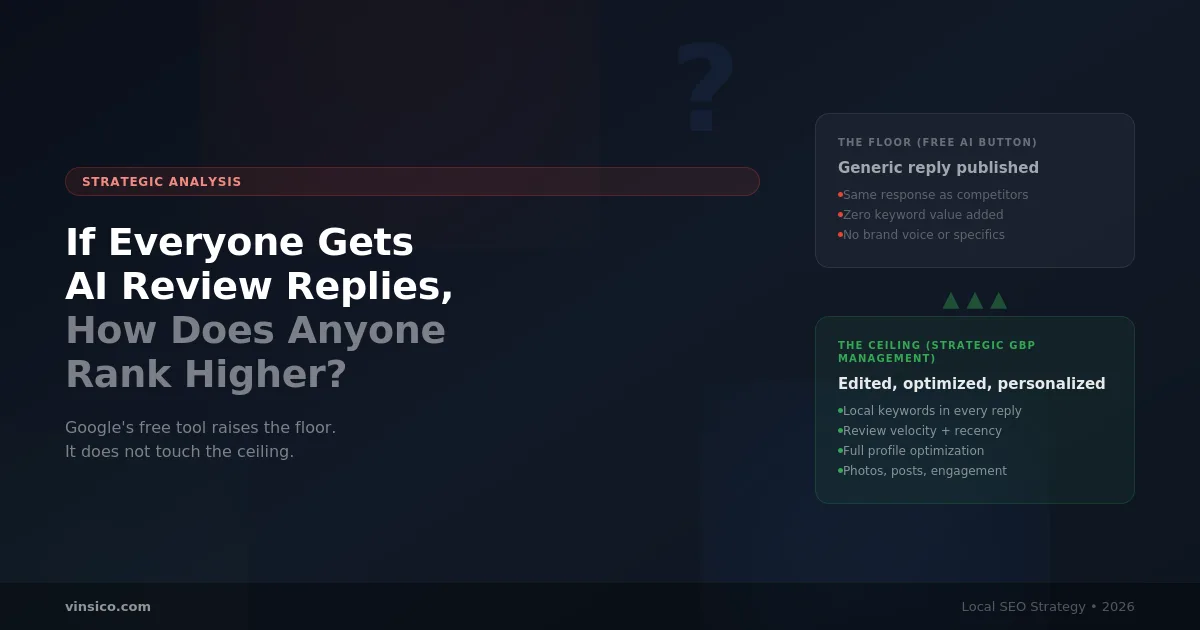
The free AI reply button does exactly one thing: it generates a basic draft response to a single review. That is the floor. Everything above that floor is where the actual competitive advantage lives.
A comprehensive GBP management approach includes review response strategy (editing AI drafts for specificity, brand voice, keyword relevance, and tone matching), but also review velocity management (processes to consistently generate new reviews), photo optimization (fresh, high-quality photos uploaded regularly), post scheduling (weekly GBP posts with relevant content), category and attribute optimization, service description updates, competitor monitoring, and performance tracking.
Google giving away free basic AI replies is like Google Docs being free. It did not kill professional writing services or content marketing agencies. It made more people realize that written content matters, and then a portion of those people realized that the free tool alone was not enough to compete seriously. The same dynamic applies here.
If anything, Google's free AI reply tool strengthens the case for managed services rather than weakening it. It educates the market. Business owners who were not thinking about review responses at all will now see the feature in their dashboard and start to understand that responding to reviews matters. Some of them will click the button, publish a few generic replies, see that their competitors are doing the same, and realize they need something better. That realization is exactly where services like InQik come in, handling the full scope of GBP optimization that no single AI button can replicate.
The AI Search Angle Most People Are Missing
There is one more layer to this that makes the quality of your review responses matter even more than traditional ranking signals would suggest.
Google's AI Overviews, ChatGPT, Perplexity, Claude, and other AI platforms are all pulling from publicly available review data when people ask questions about local businesses. When someone asks "Is [business name] good for families?" or "What is the wait time like at [restaurant name]?", these AI systems construct their answers from review content and business responses.
The Whitespark 2026 report confirms that review signals now also influence AI search visibility, not just traditional local pack rankings. This is a new dimension that did not exist even two years ago.
Here is why this matters for the "everyone gets the same tool" question: AI systems are not just checking whether a response exists. They are reading the content of responses to understand what a business is like, what it offers, how it handles problems, and what customers can expect. A generic "thank you for your feedback" response adds no useful information to that AI knowledge base. A response that says "Glad our Saturday brunch service worked well for your family. The kids menu is something we put a lot of thought into and we are happy to hear the pancakes were a hit" gives AI systems rich, specific data points about your business that they can use in future answers.
As AI search becomes a bigger part of how consumers discover local businesses, the businesses with the richest, most detailed, most authentic review content (including responses) will be represented more favorably. Generic AI responses add nothing to that picture. Thoughtful, detailed, edited responses add a lot.
The Honest Bottom Line
Will Google's free AI review reply feature eventually reduce the ranking advantage of simply responding to reviews? Yes, slightly, over time, as more businesses adopt it.
But the signals that actually drive local search rankings, review velocity, review recency, keyword specificity in responses, response speed, review quality, overall GBP engagement, and the 85-90% of ranking factors that have nothing to do with review replies, none of those are affected by Google's free tool.
The free AI reply button raises the floor. It does not touch the ceiling.
Businesses that were already ignoring their GBP will continue to ignore it, button or no button. Businesses that click the button and publish generic drafts will see a marginal improvement over silence, but they will still be outperformed by businesses that edit their responses, maintain review velocity, optimize their full profile, and treat GBP management as an ongoing strategic priority rather than an occasional chore.
The competitive advantage in local search has never been about having access to the right tools. Google gives everyone the same tools. The advantage comes from actually using them, using them consistently, and using them well. That has not changed, and a new AI button does not change it either.
If you are a business owner reading this and wondering whether you still need to invest time and effort into your Google Business Profile now that AI can reply to your reviews for you, the answer is yes. More than ever. Because your competitors just got a free tool that makes the bare minimum easier to achieve. The businesses that go beyond the bare minimum are the ones that will rank, convert, and win.