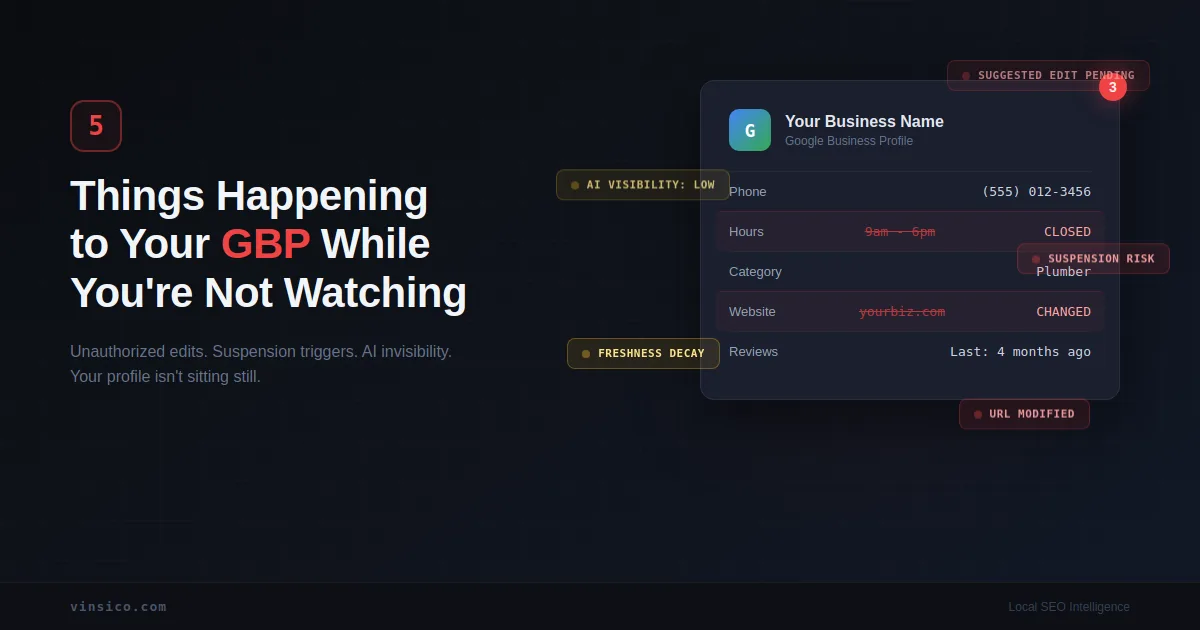
Your Google Business Profile isn't frozen in time. You set it up, verified it, maybe added a few photos, and moved on with your life. Totally reasonable. But while you've been running your actual business, your GBP has been a live document that Google, random strangers, competitors, and AI systems are all interacting with, whether you're paying attention or not.
Most business owners have no idea this is happening. They check their profile once a quarter, see it looks roughly the same, and assume nothing has changed. That assumption is costing them visibility, customers, and in some cases, their entire listing.
Here are five things that are likely happening to your Google Business Profile right now, and what you can do before the damage gets worse.
1. Strangers Are Editing Your Profile (And Google Is Letting Them)
Every Google Business Profile has a small link right below the business name: "Suggest an edit." Anyone can click it. Anyone. Your competitors, a confused customer, a bored stranger, a Maps contributor trying to earn points. They can propose changes to your business name, address, phone number, hours, website URL, categories, and even whether your business is marked as permanently closed.
Google designed this as a crowdsourcing feature to keep business data accurate. In practice, it means your critical business information is editable by people with zero accountability to you.
Here's the part that catches most owners off guard: Google often auto-accepts these suggested edits if you don't respond quickly. The notification might land in your email, or it might get buried in spam. If you miss it, the change can go live without your approval. Sterling Sky, one of the most respected local SEO agencies in the industry, has documented that even small unauthorized changes to a profile, like swapping a website URL, can cause dramatic ranking drops.
The Localogy research team confirmed the scope of this problem: users can suggest edits to virtually anything on your listing, from your primary category to your social profile links. If Google pushes an update live and it changes your primary category, you could lose your position in the local pack overnight and not understand why for weeks.
Price range edits are another blind spot. Local Biz Guys reported in February 2026 that user-suggested price range changes are hitting businesses regularly. If your moderate-price restaurant gets tagged as $$$$, budget-conscious customers scroll right past you before they ever learn what you actually charge.
And it gets worse. Reports from the Local Search Forum document cases where businesses have had their reviews and photos merged with a competitor's listing after a simple phone number change triggered an algorithmic mismatch. One business owner in October 2025 reported that after updating their phone number, a nearby supermarket appeared in their place on Google Maps, with their reviews and photos showing on the competitor's profile.
Do this: Log into your GBP dashboard at least weekly. Check the "Edit profile" section for any pending changes highlighted in orange. Enable email notifications for suggested edits in your GBP settings. Better yet, use a monitoring tool like Local Falcon's Falcon Guard or a managed GBP service like InQik that watches for unauthorized changes around the clock so you don't have to remember to check manually.
Not that: Don't assume that because you verified your profile, you control it. Verification gives you priority, not a lock. And don't rely solely on email notifications; they don't always arrive, and they're easy to miss.
2. Google's Suspension Algorithm Is Catching Legitimate Businesses
Google has been on a suspension spree, and legitimate businesses are getting caught in the crossfire. The goal, according to Google's own statements, is to clean up fraudulent and spammy listings to improve data quality for AI-powered search features. The execution has been far less surgical.
Sterling Sky's comprehensive suspension guide, updated in March 2026, documents the current landscape in detail. They report that appeal wait times hit five to six weeks in early 2025. Two types of suspensions exist: soft suspensions (your listing still shows up but is unverified) and hard suspensions (your listing is completely removed from Google Search and Maps). A hard suspension means your phone stops ringing. Immediately.
The triggers that catch legitimate businesses are infuriatingly mundane. Sterling Sky has documented suspensions triggered by adding a UTM tracking string to a website URL, changing a phone number, having a middle initial mismatch between your GBP name and your business license, or simply having your profile managed by an agency whose Google account got flagged for unrelated reasons. If your marketing agency gets an account-level suspension, every GBP they manage can go down with them.
The Local Search Forum thread on suspension spikes from late 2025 paints a grim picture from practitioners in the trenches. One agency managing over 1,000 profiles reported getting one to three suspensions per week, with triggers that are, in their words, "all over the place." Another practitioner described submitting a video verification for a brand new business, having it process for 18 hours, and then getting immediately suspended for a policy violation with no further explanation.
Google also completed the March 2026 spam update in under 24 hours, the fastest spam update in Google's dashboard history. It applies globally, to all languages. Google didn't publish new spam policies alongside it, which means the existing guidelines are the framework, but the enforcement threshold may have shifted without warning.
Do this: Keep a digital evidence folder with photos of your storefront and signage, your business registration, utility bills proving your address, and any professional licenses. If you ever face a suspension, this documentation is what you'll need for the appeal. Avoid making multiple profile changes in quick succession; space out edits over days, not minutes. Use a domain-based business email ([email protected]) as the primary owner on the profile, not a personal Gmail.
Not that: Don't make a phone number change, a category update, and a URL edit all on the same day. Don't let multiple agencies or freelancers have manager access to your profile with personal Gmail accounts. And don't panic if you get suspended, but do act fast. Sterling Sky's data shows that profiles reinstated quickly tend to return to their previous ranking positions. Profiles suspended for months return to a different competitive landscape.
3. AI Is Deciding Whether to Recommend You (And It Probably Isn't)
This is the shift most business owners haven't processed yet. According to BrightLocal's 2026 Local Consumer Review Survey, 45% of consumers now use AI tools like ChatGPT, Gemini, and Perplexity for local business recommendations. That number was 6% just one year earlier. A 650% increase in twelve months.
AI is now the third most-used discovery channel for local businesses, behind only Google and Facebook. It passed Yelp. It passed Tripadvisor. And it's still accelerating.
But here's the number that should genuinely alarm you: SOCi's 2026 Local Visibility Index, which analyzed over 350,000 business locations across 2,751 brands, found that ChatGPT currently recommends just 1.2% of all local business locations. Gemini recommends brands only 11% of the time. That's a brutal gap. Nearly half of consumers are now asking AI where to go, and AI can name barely any of them.
Whitespark's 2026 Local Search Ranking Factors report added AI Search Visibility as a formal ranking category for the first time in the survey's nearly 20-year history. The report, based on input from 47 local SEO practitioners evaluating 187 factors, found that three of the top five AI visibility factors are citation and entity-based signals. Directory listings nearly doubled in importance for AI visibility compared to their weight in traditional Google results.
AI doesn't pull recommendations from your GBP the way Google's map pack does. It pulls from a combination of review sentiment, directory accuracy, structured data on your website, and mentions across the web. If your business data is inconsistent across directories, if your reviews are old and sparse, if your website lacks structured schema markup, AI systems simply don't have enough confidence to recommend you.
BrightLocal's 2026 data also shows that 68% of consumers will only use a business rated four stars or higher, up from 55% the previous year. The businesses getting AI recommendations tend to have 100-plus reviews with recent activity and consistent data across every platform consumers actually check. Consumers are now using an average of six different review platforms, not just Google.
Do this: Ask ChatGPT, Gemini, and Google with AI Overviews enabled for a recommendation in your category and your city. See what comes back. If you're not mentioned, you now know the gap exists. Start building the signals AI needs: consistent NAP data across directories, recent reviews with genuine sentiment, LocalBusiness schema markup on your website, and service-specific landing pages that answer the questions customers actually ask.
Not that: Don't assume that because you rank well in the traditional map pack, AI knows you exist. Different systems, different data sources, different recommendations. And don't ignore directories you've never heard of. BrightLocal's research on ChatGPT's search sources found that when it tested dental queries, ChatGPT pulled exclusively from ten dental directories, not from Google profiles or dentist websites.
4. Google Killed Your Q&A Section and Replaced It With AI You Don't Control
If you had useful questions and answers on your Google Business Profile, they're gone or going. Google discontinued the Q&A API in November 2025 and began deprecating the public-facing Q&A section in December 2025, with full removal rolling out gradually over one to three months.
The replacement is "Ask Maps," an AI-powered feature built on Google's Gemini model. Instead of customers reading answers you wrote, Google's AI generates answers about your business by pulling from your reviews, business description, photos, service listings, and other profile data. The customer asks a question. AI answers it. You don't get a say in what that answer looks like.
This changes the stakes for profile completeness entirely. Under the old system, you could seed your Q&A section with the five questions customers asked most and write clear, accurate answers. You controlled the narrative. Under the new system, Google's AI constructs its own answers from whatever data you've given it. If your service list is incomplete, AI won't mention services you offer. If your business description is vague, AI will give vague answers. If your reviews mention long wait times or rude staff, AI may summarize that sentiment directly to potential customers.
Multiple practitioners have reported that Ask Maps is already appearing for some industry searches but not others. Footbridge Media tested in November 2025 and found it active for pressure washing, roofing, HVAC, painters, and remodelers, but not yet for electricians, tree services, plumbers, pest control, or landscaping. The rollout is inconsistent across devices, too. Mobile, desktop, and the Maps app may show different experiences.
Do this: Treat your GBP business description as a high-value information source, because that's exactly what it is now. Make it specific, keyword-rich, and comprehensive. List every service you offer in the GBP services section. Audit your reviews for recurring complaints and address those issues operationally, because AI will summarize them. If you had important FAQ content in your Q&A section, migrate those answers into your business description, your website, and your GBP posts.
Not that: Don't assume the transition is months away for your industry. It's rolling out in waves. Don't leave your services section half-completed. AI fills in nothing for what you don't provide; it just stays silent, which means customers hear about your competitors instead.
5. Your Profile Is Actively Decaying (Even If Nobody Touches It)
A GBP that nobody edits, updates, or interacts with doesn't just stay neutral. It loses ground. Google's algorithm increasingly treats inactivity as a negative signal, and the data backs this up.
Agency Jet reported in January 2026 that businesses which hadn't posted an update or added a photo in over 30 days saw dramatic drops in GBP impressions. Not gradual declines. Dramatic drops. Google interprets silence as disengagement, and it responds by showing your profile to fewer people.
The Whitespark 2026 Local Search Ranking Factors report confirms this trend from multiple angles. Review recency now outweighs total review count as a ranking and conversion signal. A business with 200 reviews, all earned before 2024, sends a weaker signal than a business with 60 reviews earned steadily over the past six months. Being open at the time a user searches is now the fifth most influential local pack ranking factor, based on research first documented by Joy Hawkins of Sterling Sky and validated in the 2026 report. Your posted hours aren't just informational; they're actively determining whether Google shows you to searchers.
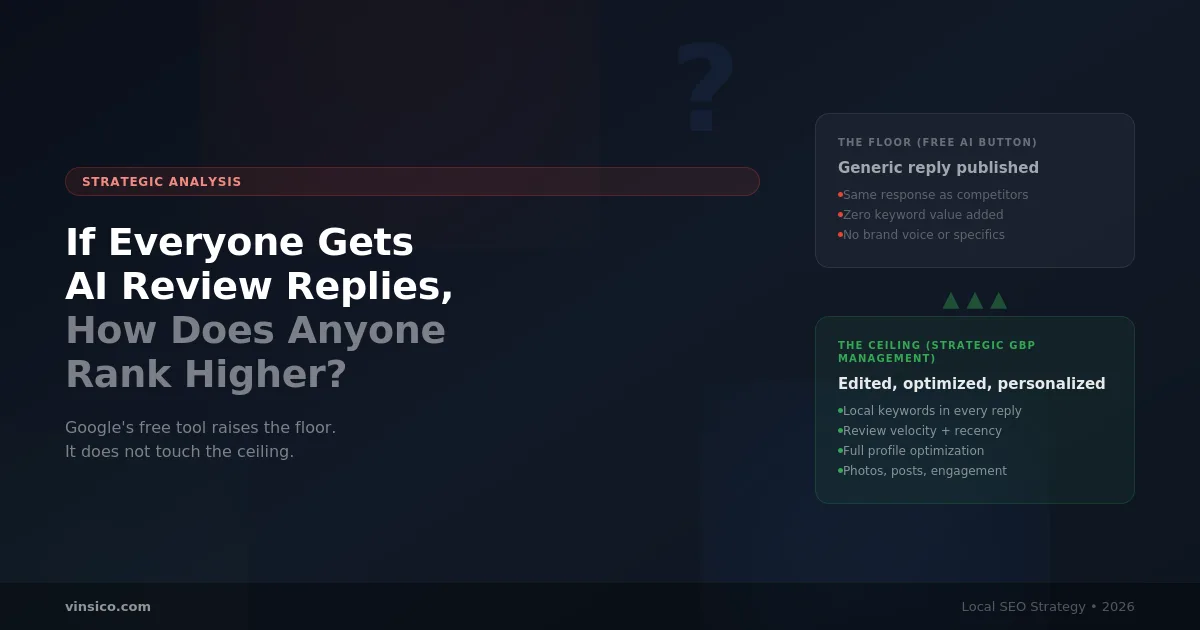
BrightLocal's 2026 consumer data adds another layer: 50% of consumers say that generic or templated review responses make them less likely to choose a business, while 88% say they'd use a business that responds to both positive and negative reviews. Only 47% would consider a business that doesn't respond to reviews at all. Your silence isn't neutral. It's a signal that you're not paying attention, and both Google's algorithm and actual humans interpret it the same way.
The compounding effect works in both directions. Active profiles earn more visibility, which drives more interactions, which further improves rankings. Inactive profiles lose visibility, which means fewer interactions, which accelerates the decline. Once decay sets in, recovering the lost ground takes significantly more effort than maintaining it would have.
Do this: Set a recurring weekly task to post a GBP update. It doesn't need to be elaborate. A recently completed project, a seasonal note, a staff update, a new product. Post something real. Upload new photos at least twice a month, real photos of your work, your team, your space, not stock imagery. Respond to every review within 48 hours, and write responses that reference specific details from the review rather than copy-pasting the same generic "Thanks for your feedback!" across the board.
Not that: Don't batch all your activity into one frantic quarterly session. Google rewards consistency, not bursts. Don't upload 40 photos in January and nothing until April. Don't rely on automated review response tools that produce identical responses for every review; consumers spot this instantly, and it actively hurts perception.
What This Actually Costs You
None of these five problems announce themselves. Your phone doesn't ring less with a push notification explaining why. Customers who would have found you through AI simply find your competitor instead. A suggested edit that changes your hours doesn't send you a text. A freshness penalty doesn't show up in your email.
The cost is invisible, which is what makes it so dangerous. By the time most business owners notice something is wrong, the damage has been compounding for months.
The fix isn't complicated, but it does require consistent attention. Weekly profile checks. Ongoing review management. Regular posting and photo uploads. Directory consistency across the platforms that AI actually pulls from. This is maintenance, not a one-time project.
For businesses that want to handle this themselves, tools like BrightLocal (auditing and review monitoring), Whitespark (citation management and rank tracking), and Local Falcon (geo-grid tracking and edit monitoring) cover the essential bases. For owners who would rather not manage their profile at all, managed services like InQik handle monitoring, posting, review response, and edit protection end to end, which makes sense when the alternative is finding out three months from now that someone changed your website URL and you've been bleeding rankings the entire time.
Either way, the worst option is the one most businesses are currently choosing: doing nothing and hoping the profile takes care of itself.
Go check yours. Today.