If you've ever wondered why some businesses show up at the top of Google Maps and others don't, you're not alone. It's one of those things that looks random at first but actually follows a pretty clear logic once you dig into it. Google hasn't published a step-by-step formula, but between their own official documentation and years of research from the local SEO community, we have a pretty good picture of what actually moves the needle.
This article pulls from Google's official guidance, the 2026 Whitespark Local Search Ranking Factors survey (47 of the world's leading local SEO experts contributed to it), BrightLocal's research, and observations from people who work in local SEO day in and day out.
Google's Three Official Ranking Factors
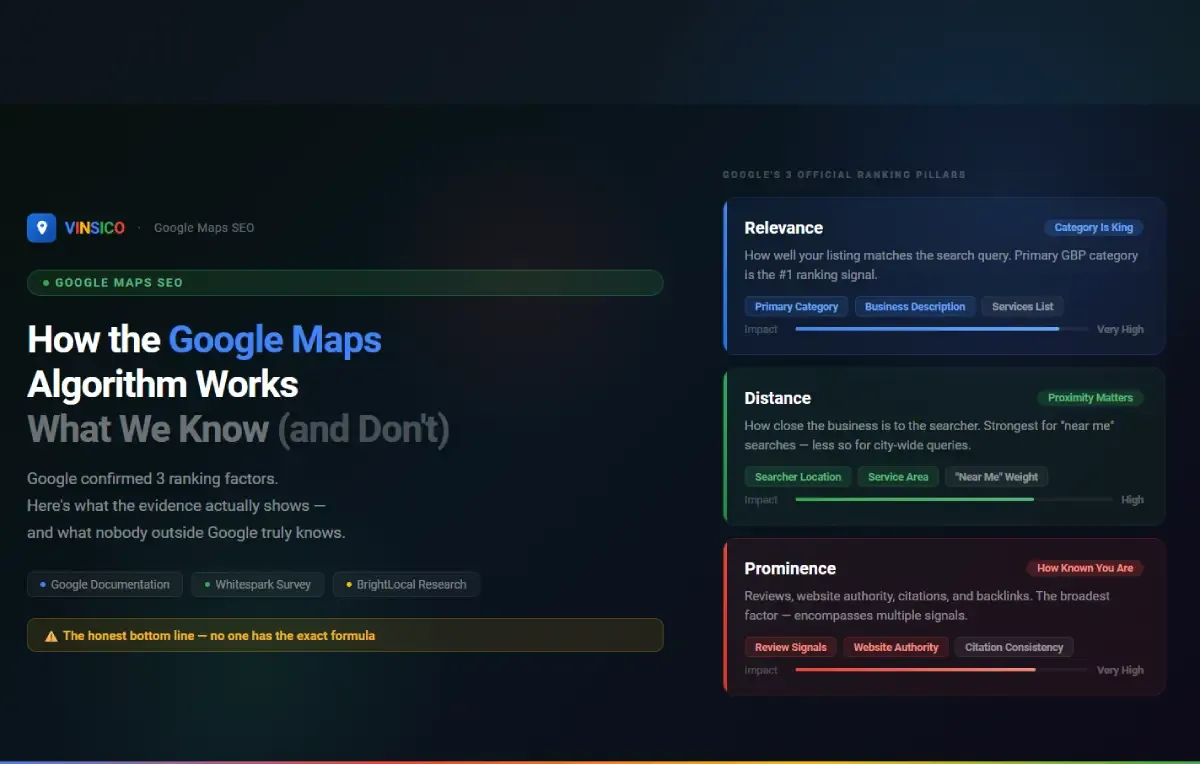
Google has publicly said that local search results are determined by three things: Relevance, Distance, and Prominence. That's straight from their own help documentation. The problem is those three words don't tell you much on their own. What does "prominence" actually mean in practice? How much does distance really matter? That's what this article is here to answer.
There's also a fourth factor that the SEO community has been paying close attention to lately: Behavioral Signals. More on that below.
Relevance: Google Needs to Know What You Are
Relevance is simply about whether your business matches what someone is searching for. And the biggest thing that tells Google what your business is? Your primary Google Business Profile (GBP) category.
The 2026 Whitespark survey found that GBP signals as a whole account for around 32% of local pack ranking influence, which makes it the most important category by far. And within that, your primary category sits at the top. Think about it this way: if someone searches "Italian restaurant near me," Google has to figure out which businesses are Italian restaurants. Your category is the clearest signal you can give it.
You can also add secondary categories to your profile, and that does help. Research from BrightLocal shows businesses using multiple relevant categories tend to rank better on average. Just make sure every category you pick actually describes your business. Adding categories that don't fit won't help and can actually work against you.
One thing that comes up a lot is keywords in the business name. There's real evidence that a business called "Austin Emergency Plumbing" will rank better for plumbing searches than one called "Joe's Services." But Google's rules are clear: you can only use your actual legal business name. Adding extra keywords that aren't part of your real name is against their guidelines and can get your listing suspended. It's not a shortcut worth taking.
Other things that contribute to relevance include your business description, your services list, and your Q&A section. These all matter, just not as much as getting your primary category right.
Distance: It Matters, But Not as Much as It Used To
Of course Google considers how close a business is to the person searching. For "near me" searches especially, proximity carries a lot of weight. You can test this yourself by searching for something on your phone and then comparing those results to what someone across town gets. They won't be the same.
But here's what's changed: distance is less dominant than it was a few years ago. The 2026 data suggests Google has been shifting weight toward relevance and prominence instead. What this means in practice is that a well-reviewed, well-optimized business can outrank a competitor that's physically closer. You're not automatically losing just because your location isn't ideal.
There's also an important distinction depending on how someone phrases their search. If they search "plumber near me," proximity matters a lot. If they search "plumber in Austin," Google opens up the competitive radius to the whole city, not just the area around the searcher. Knowing this changes how you think about who you're actually competing against.
Prominence: How Well-Known and Trusted Your Business Is
Prominence is the broadest of the three, and it covers a lot of ground. It's basically Google's way of measuring how established and credible your business is, both online and in the real world.
Reviews Are More Important Than Ever
Reviews are one of the clearest signals of prominence, and their weight has been growing. According to the 2026 Whitespark survey, review signals now account for around 20% of local pack rankings. In 2023 that number was 16%. That's a meaningful jump in a short period of time.
But it's not just about having a lot of reviews. There are a few things that matter specifically:
- How recent your reviews are. A business getting steady reviews every week is going to outperform one with 200 old reviews and nothing new in months. Recency is now one of the top individual ranking factors.
- What people actually write in their reviews. Google reads the text, not just the star rating. Reviews that mention specific services, locations, or experiences carry more weight than generic ones. This matters especially for AI-generated search results, which are becoming more common.
- Whether you respond to reviews. Google's own documentation encourages business owners to respond to reviews, both good and bad. Responding consistently appears to help visibility.
- Whether your reviews are real. Google's August 2025 spam update went specifically after fake review activity. If your reviews aren't genuine, you're taking a real risk with your listing.
Your Website Still Matters
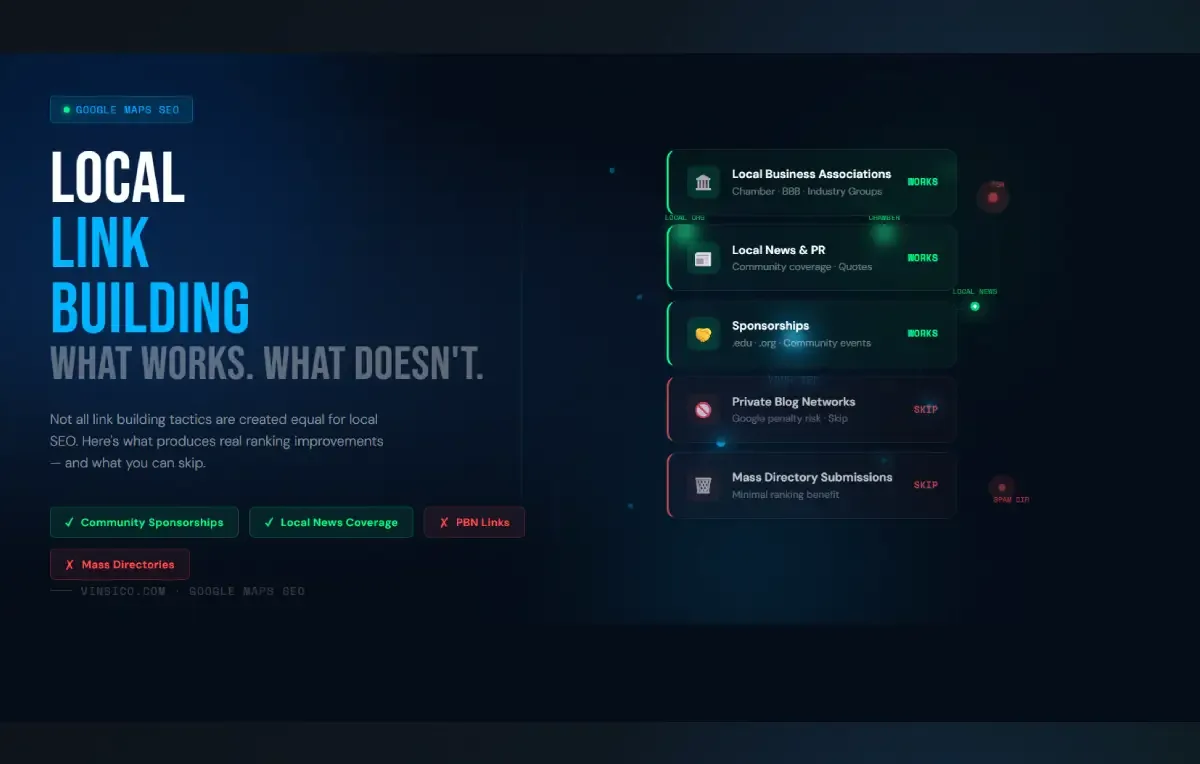
Having a solid website behind your GBP listing makes a difference. Businesses with established websites, good links coming in from local and relevant sources, and well-structured pages tend to do better in the local pack than those with weak or non-existent sites.
One thing the 2026 data makes clear: having a dedicated page for each service you offer is one of the strongest things you can do. A single generic "Services" page that lists everything is much weaker than individual pages built around specific services. If you offer five things, build five pages.
Citations: Your Business Info Across the Web
Citations are just mentions of your business name, address, and phone number on other websites, like Yelp, Yellow Pages, industry directories, and so on. They've been a local SEO staple for years, and they still matter, but the way they matter has shifted.
For traditional Google Maps rankings, the direct impact of citations has probably gone down a bit as Google has gotten better at understanding business information on its own. But for AI-driven search results, citations have become more important. Tools like ChatGPT and Google AI Overviews pull from the same sources, and having consistent, accurate business information across trusted directories is one of the top signals for showing up there.
The practical takeaway: make sure your business name, address, and phone number are accurate and consistent everywhere. Conflicting information costs you. And focus on quality directories, not quantity.
Behavioral Signals: What People Do When They Find You
This is the category that often gets left out of conversations about local SEO, but the 2026 data makes clear it's a real ranking factor now. Behavioral signals are about what users actually do when they come across your listing.
Things like:
- Clicking through to your website or profile from search results
- Calling your business directly from your GBP listing
- Requesting directions to your location
- Spending time on your website after clicking through
- Clicking on your photos
The idea behind this is straightforward. If people consistently click on your listing, call you, and ask for directions, Google takes that as a sign that your business is relevant and worth showing to more people. It's the algorithm picking up on what real humans are actually doing.
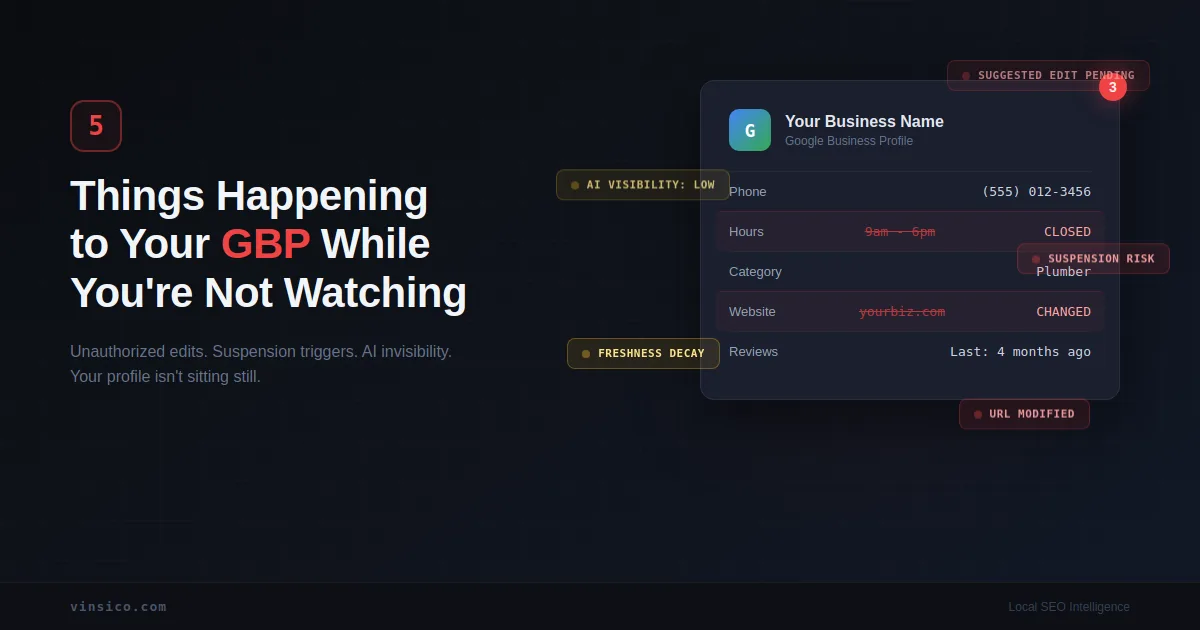
One related thing worth knowing: your listed business hours now matter more than most people realize. Businesses that show as open at the time of the search rank better than ones that show as closed. If your hours are wrong or outdated in your profile, fix that now.
Social Signals Are Back
This one surprised a lot of people in the SEO community. The 2026 Whitespark survey brought social signals back as a confirmed ranking factor for the first time since 2018. Local engagement on Facebook, Instagram, and similar platforms, things like community activity and consistent posting, has been confirmed as contributing to local visibility. It's not a massive factor, but it's no longer something you can ignore entirely either.
AI Search: Something New to Pay Attention To
The 2026 Whitespark survey included AI search visibility as a category for the first time, which tells you something about how quickly the landscape is changing. More and more searches are now being answered by AI tools, whether that's Google AI Overviews, ChatGPT, or Perplexity. And those tools are pulling from the same data that drives traditional local rankings.
If you're already doing the fundamentals well, you're in decent shape for AI visibility too. But a couple of things carry extra weight in that context: having well-structured, service-specific pages on your website, and having accurate citations across trusted directories. Review signals also play a bigger role in AI results than you might expect.
Another thing that's come up in recent research: businesses that appear on "Best Of" or "Top Local" lists on credible editorial sites are seeing ranking benefits. Being listed as one of the best plumbers in Denver on a trusted local site is starting to function as a real trust and authority signal, both for traditional rankings and AI results.
Things That Probably Don't Matter as Much as You Think
A few things that business owners often focus on that the data suggests don't carry much direct ranking weight:
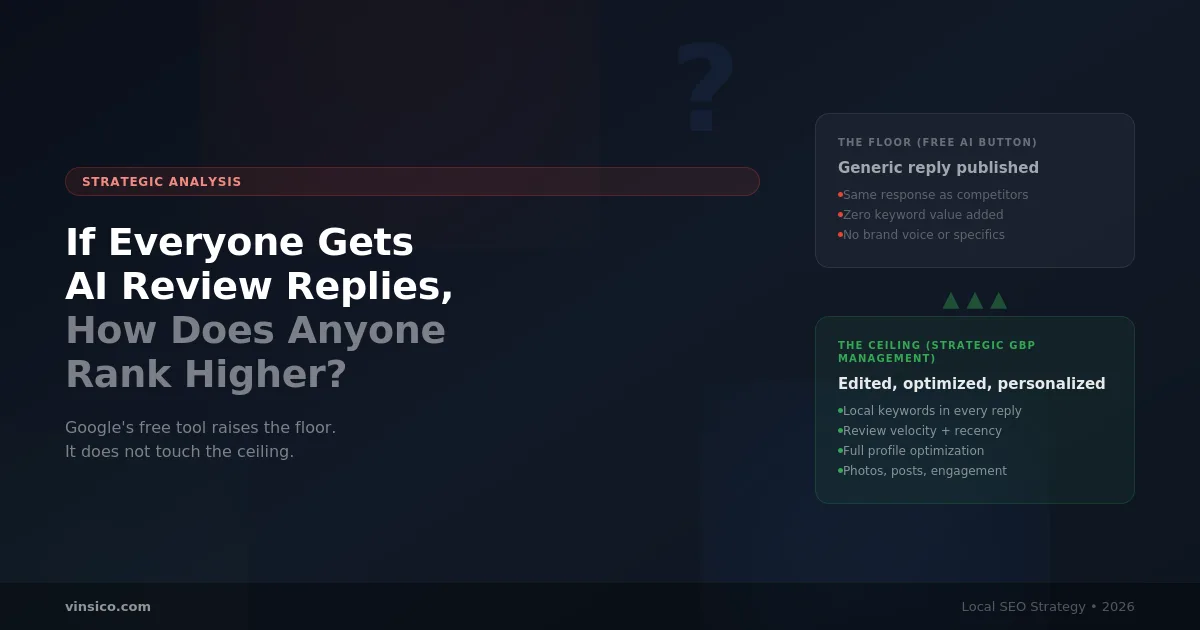
- Posting to Google Business Profile constantly. Publishing posts on its own isn't going to move your rankings. What matters is whether those posts generate engagement. Activity without interaction doesn't help much.
- Having a ton of photos. Uploading hundreds of photos won't push you past a competitor with fewer but better ones. What does matter is whether your photos get clicks and views, and whether they have location data attached.
- Your average star rating by itself. A 4.5-star rating does not automatically beat a 4.2. The number of reviews, how recent they are, and what they say are all more influential than the average score alone.
So What Should You Actually Focus On?
Nobody outside of Google knows exactly how the algorithm works. Anyone claiming otherwise is overselling. But based on everything we know from official guidance and years of research, here's where your energy is best spent:
- Get your GBP category right. It's the single most important signal you control.
- Build a review strategy that generates fresh, genuine reviews consistently. Not a one-time push.
- Make sure your website has individual pages for each service you offer, with real content on each one.
- Keep your business information consistent everywhere it appears online.
- Think about the experience people have with your listing. A profile with good photos, accurate hours, and clear information gets more clicks and calls, which feeds back into rankings.
The businesses doing well in Google Maps right now aren't winning because they found a clever trick. They're winning because their online presence actually reflects what they offer, and real customers keep showing up and engaging with it. That's what the algorithm is trying to measure, and that's what you should be building toward.