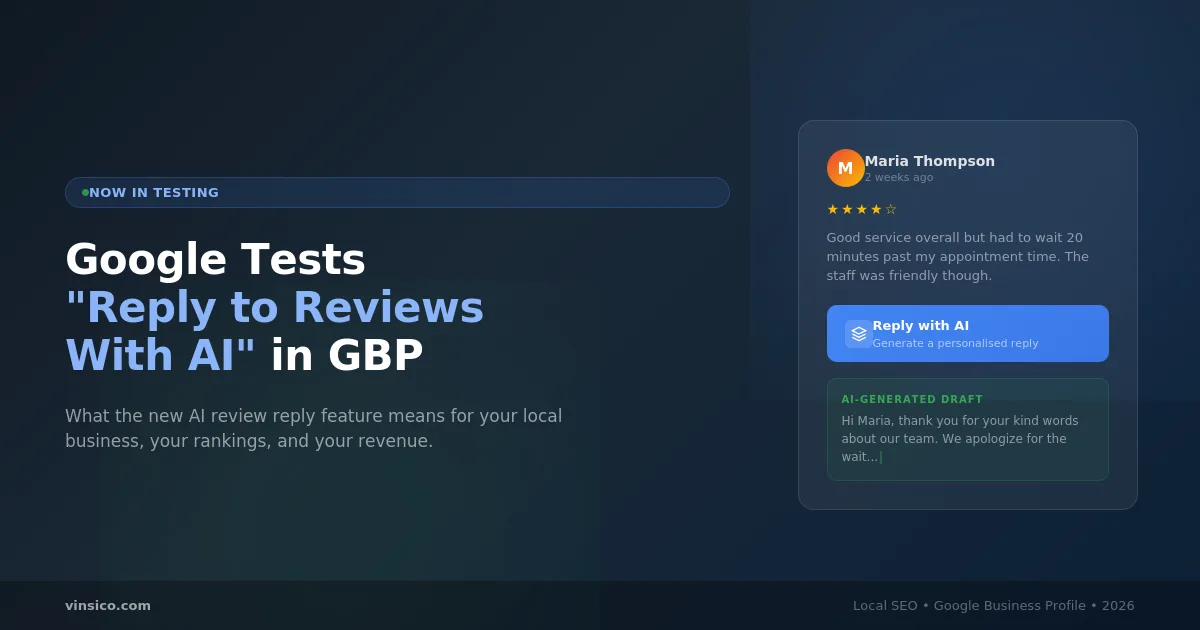
Google just dropped a quiet but significant test inside Google Business Profile. Some business owners are now seeing a new option in their reviews section that says "Reply to reviews with AI" followed by the line "Use Google AI to create personalised replies that build trust."
The feature was first spotted and shared on LinkedIn by CK Mishra, a freelance local SEO specialist based in India, and quickly picked up by Darren Shaw, founder of Whitespark. Barry Schwartz covered it on Search Engine Roundtable. Search Engine Land followed up with their own reporting. Within days, it became one of the most discussed local SEO developments of 2026 so far.
And for good reason. If you run a local business, manage client profiles, or work anywhere in local SEO, this changes how review management works at a fundamental level. Not because the AI is perfect. It is not. But because Google is now actively trying to solve a problem that has plagued local businesses for years: most of them never reply to their reviews.
Let us break down what is happening, why it matters more than most people realize, and how to actually use this without making things worse.
What the Feature Looks Like Right Now
Inside the reviews section of Google Business Profile, accounts that have access see a prompt to generate an AI reply for individual reviews. You click it, Google's AI reads the review, and it produces a draft response. You can then edit the draft, rewrite parts of it, or submit it as is.
Some versions of the test also support bulk replies across multiple reviews at once. That last part is where things get interesting and a little risky, but we will get to that.
Here is what CK Mishra said about his experience testing it: he gave it a try and found it promising but not fully optimized yet. The feature directed him to an older one-star review and prompted him to generate a suggested reply. The response it produced was actually quite decent. But when he tried to use the same feature for other unanswered reviews, the option was not available.
That inconsistency is a theme across the board right now. Not every account has the feature. Not every review within an account shows the option. Some businesses in the same city can see it while the shop next door cannot. Google has not made a formal announcement, and there is no public timeline for a wider rollout.
What we do know is that the feature has been spotted in the United States, Brazil, and India. European availability appears to be extremely limited or nonexistent based on current reports.
There are also conflicting reports about how automated the process is. Some users say every reply requires manual review and submission. Others say bulk responses can go out without individual editing. Until Google clarifies this officially, the smart move is to review and edit every single reply before it gets published. No exceptions.
The Problem Google Is Trying to Solve
This feature did not come out of nowhere. Google can see in its own data just how bad the review response problem has become, and the numbers are honestly kind of shocking when you lay them all out.
97% of consumers who read reviews also read the business's responses to those reviews. That number comes from research aggregated by ReplyOnTheFly, and it means almost every single person checking your star rating is also looking at what you wrote back. Or did not write back.
And here is the painful part: 63% of consumers say a business has never responded to their review. Two out of three people who take the time to leave feedback get nothing in return. No acknowledgment. No thank you. Nothing.
It gets worse when you look at timing. ReviewTrackers found that 53% of consumers expect a response to a negative review within one week, and 38% want a reply within two to three days. Meanwhile, SOCi research shows that 87% of businesses fail to respond to negative reviews within what consumers consider an acceptable timeframe.
Google hosts roughly 73% of all online reviews worldwide. That is not a typo. Nearly three quarters of every review posted anywhere on the internet lives on Google. When the majority of those reviews sit unanswered, it degrades the usefulness of the entire ecosystem Google has built around local business discovery. Of course they are going to try and fix that with AI.
Why Review Responses Directly Impact Your Revenue
This is not a "nice to have" situation. The revenue impact of review responses is documented and substantial.
Businesses that respond to all their reviews see up to 18% higher revenue compared to businesses that do not. That comes from industry research compiled by ReplyOnTheFly. If your business does $500,000 a year, that is potentially $90,000 you are leaving on the table by not responding. At $1 million in revenue, the gap grows to $180,000.
A 2026 Clutch report found that 96% of consumers now look for reviews before making a first-time purchase. That is up from 88% just five years ago. The trend is going in one direction only.
BrightLocal data shows 89% of consumers are more likely to choose a business that replies to all its reviews. That is 102% higher preference compared to businesses that ignore their reviews entirely. Think about that for a second. Just the act of replying, consistently and thoughtfully, roughly doubles your chances of being chosen over a competitor who does not.
And the impact on negative reviews is particularly telling. 44.6% of customers will continue doing business with you if you respond to their negative review. 80% of unhappy customers say they would even leave a positive follow-up review if you resolved their issue to their satisfaction. Responding to a negative review is not damage control. It is a conversion opportunity that most businesses completely waste.
Reviews lift conversion rates by 15-20% on their own, and displaying five or more reviews can boost conversions by up to 270%. Consumers will spend 31% more with a business that has excellent reviews. These are not theoretical numbers. They show up in actual sales data across industries.
There is one important caveat here though. Trust in online reviews has actually been declining. In 2020, 79% of consumers trusted reviews as much as personal recommendations from people they know. By 2025, that number dropped to 42%. The likely cause is growing awareness of fake reviews and AI-generated content. Which means the authenticity of your responses matters more now than at any point in the last decade. Generic, robotic replies will accelerate that trust erosion, not reverse it.
How Review Responses Affect Your Local Search Rankings
Beyond the direct revenue impact, review responses feed into the local search ranking factors that determine whether your business shows up in Google's Local Pack or gets buried where nobody looks.
The Whitespark Local Search Ranking Factors report is published annually and surveys dozens of the top local SEO practitioners in the world. The 2026 edition delivered a clear message: local algorithms now reward businesses that look active and genuinely interact with their customers. Setting up a profile and forgetting about it no longer cuts it.
Darren Shaw has been especially vocal about review recency as a ranking factor. In his analysis, he placed it in his personal top five most important local ranking factors for 2025, up from its official ranking of 20th in the 2023 survey. His argument is that Google has significantly increased the weight given to how recently and consistently a business is receiving and engaging with reviews.
A Joy Hawkins case study from 2023 illustrated this with actual data. When a business owner rewarded staff for encouraging customers to leave reviews, rankings went up. When they stopped the incentive program, reviews slowed down and rankings dropped. When they restarted it, rankings recovered. The correlation was direct and visible in the tracking data.
Review responses contribute to local rankings through several channels.
Engagement signals tell Google a business is active. The 2026 Whitespark report specifically calls out review activity as one of the behavioral engagement signals gaining influence, alongside posts, photos, clicks, calls, and direction requests.
Keyword content in responses gets indexed. When you reply to a review that mentions "kitchen remodeling in Phoenix" and your response naturally references your Phoenix remodeling team, you are adding keyword-relevant content to a page Google indexes. It is not keyword stuffing. It is organic reinforcement of local relevance.
Click-through rates improve when consumers see an active review section. People are more likely to click on a listing where the business is clearly engaging with customers. Google tracks that click behavior.
E-E-A-T signals get reinforced. Google's Experience, Expertise, Authoritativeness, and Trustworthiness framework rewards businesses that show knowledgeable, authentic engagement. Thoughtful review responses are one of the very few visible E-E-A-T signals a local business can produce without creating separate content pieces.
The numbers round it out: top-ranking businesses in Google's Local Pack average about 47 reviews. Review signals collectively account for an estimated 10-15% of local SEO ranking factors. And the businesses that hold their positions are not just the ones with the most reviews. They are the ones with the most consistent review velocity and the most active response behavior.
Where This Goes Wrong: The Real Risks of AI Review Replies
Now for the part that too many people will skip over and later regret.
Search Engine Land flagged this directly in their coverage: response quality matters more than whether a business replies at all. A generic AI reply that could have been pasted onto literally any review on the internet is not just unhelpful. It can actively damage trust in ways that take months to repair.
Here is what goes wrong.
Generic language stands out immediately. When a customer writes a detailed one-star review about a specific bad experience, maybe a wrong order, a rude interaction, a billing mistake, and the response comes back with "Thank you for sharing your feedback. We value your input and hope to serve you again soon," every single person reading that exchange can see the business did not actually read the review. They did not address the problem. They just hit a button. That reads worse than no response at all.
Repetitive patterns become obvious fast. If every response on your profile opens with the same phrase and closes with the same phrase, consumers notice the pattern. It signals automation, not care. And with 97% of review readers also reading responses, this pattern will be visible to nearly everyone evaluating your business.
AI can put wrong information in the response. Without editing, a generated reply might include a phone number that has changed, a policy that no longer applies, or a reference to a promotion that ended last month. Sending a frustrated customer to a dead phone number makes a bad situation worse.
Bulk publishing removes all human judgment. In the versions of this feature that let you publish multiple AI responses at once without editing each one, the risk compounds. You could end up with 30 identical-sounding responses going live simultaneously. That creates a review section that looks more like a spam operation than a business that cares about its customers.
And here is the newer concern: 46% of consumers now say they suspect a review is fake when it reads like AI wrote it. That suspicion extends to responses too. If your replies sound mechanical, a growing percentage of potential customers will discount them entirely.
How to Use AI Review Replies Without Destroying Trust
The answer is not to avoid AI-assisted review responses. The answer is to use them as a drafting tool and keep human judgment in the editing and publishing stages. Whether you are using Google's native feature, a third-party platform, or a managed GBP optimization service like InQik that handles review responses as part of a broader profile management workflow, the framework is the same.
Treat every AI draft as a rough draft
Read the generated response before you submit it. Ask yourself one simple question: does this reply specifically address what the reviewer actually said? If a customer mentioned a specific product, a specific staff member, or a specific date, your response needs to acknowledge that detail. If the draft misses it, you add it. Five seconds of editing turns a forgettable reply into a personal one.
Use the reviewer's name and reference specifics
Google reviews show the reviewer's display name. Use it. "Hi Sarah, really glad our Tuesday evening yoga class worked well for your schedule" performs on a completely different level than "Thank you for your review." The name is right there. Use it.
Adjust your tone based on the review type
Positive reviews deserve genuine warmth and specific appreciation. Do not just say thanks. Identify what they praised and reinforce it. "Glad the installation crew was on time and cleaned up properly. That is something we specifically train our teams on." That kind of response tells every future reader exactly what to expect from your business.
Neutral reviews need honest acknowledgment and a reason to come back. Something went fine but not great. Own it and give them a reason for a second visit.
Negative reviews require the most careful handling. Acknowledge the specific issue. Take responsibility without getting defensive. Offer a concrete next step like a phone number to call or an email address for follow-up. Keep it professional and empathetic. This is where AI drafts need the heaviest editing, because negative reviews are where authenticity matters the absolute most.
Work keywords into responses naturally
Review responses are indexed by Google. When a customer mentions "plumbing repair" and you respond with "glad our Austin plumbing team could take care of that for you," you are reinforcing local keyword relevance in a completely natural way. Do not force it. But do not miss the opportunity either. Every response is a small piece of indexable content tied to your GBP listing.
Respond within 24 to 48 hours
73% of consumers only trust reviews from the last 30 days. Response speed signals that your business is paying attention. Prioritize new reviews, especially anything three stars or below. The AI drafting tool speeds up the writing stage. But do not let drafts sit in a queue for days before you edit and publish them.
Never publish bulk AI responses without editing each one
Even if the feature lets you batch publish, do not do it. Draft in bulk if you want. Then sit down and edit each response individually. Then publish one at a time. The extra time per response is trivial compared to the reputational cost of publishing 30 cookie-cutter replies at once. If you are managing multiple locations and cannot handle the volume manually, that is exactly the kind of problem where a managed service like InQik pays for itself, because they combine AI-driven efficiency with human editorial review at scale.
Google's Bigger Play: AI Across the Entire Local Search Stack
This review reply feature is not a standalone experiment. It fits into a much larger pattern of Google weaving AI into every layer of the local search experience.
Google already offers AI-powered business description suggestions inside GBP. Gemini features are embedded across Google Workspace. AI Overviews in Search are pulling review content into the summaries that appear at the very top of search results. And on the enforcement side, Google used AI to block or remove more than 240 million policy-violating reviews and more than 12 million fake business profiles in 2024 alone.
The Whitespark 2026 report confirms this trajectory is reshaping what matters for local visibility. Engagement and behavioral signals are gaining weight. Social signals have been confirmed as a measurable ranking factor for the first time ever. And website quality, specifically localized content and strong internal linking, has bounced back as a factor after several years of decline.
For the first time in the report's history, social engagement has been recognized as directly influencing local rankings. That is a significant shift and it reinforces the broader theme: Google wants to see that businesses are alive, active, and engaged with their communities. Review responses are just one piece of that puzzle, but they are an important one.
Your Reviews Now Feed AI Search Answers
Here is the part that almost nobody is talking about yet, and it might be the most consequential angle of all.
Google's AI Overviews, those AI-generated summaries at the top of many search results, are increasingly pulling from review content to answer questions about local businesses. When someone asks "Is [business name] good for families?" or "Does [restaurant name] have outdoor seating?", the AI Overview can draw from review text and your responses to construct its answer.
This is not limited to Google. ChatGPT, Perplexity, Claude, and other AI platforms all synthesize publicly available data, including Google reviews, when people ask about local businesses.
A study by Will Do SEO looked at 1,000 restaurant queries and found that businesses in the top three of local packs had a 25.9% chance of appearing in Gemini AI responses. Yes, that means about three quarters of top-ranked businesses are not featured in AI results yet. But the direction is clear. AI integration is increasing, not decreasing.
What this means for you: the words in your reviews and the words in your responses are now raw material for AI systems that millions of people use to make decisions. Businesses with rich, detailed, well-responded review profiles will be represented more favorably in these AI answers. Businesses with thin, unanswered, or generically-responded reviews will either be represented poorly or ignored entirely.
This turns review management from a reputation exercise into a content strategy. The language you use when responding, the issues you address, the local details you mention, all of it feeds the information layer that AI systems draw from. Every thoughtful response is building your brand's representation across platforms you do not even control.
Third-Party Tools vs. Google's Native Feature
Google's built-in AI reply tool is brand new and still in limited testing. Meanwhile, a bunch of third-party platforms have been doing AI review response generation for a while now, often with more depth than what Google currently offers.
Tools like Birdeye, Podium, ReviewFlowz, Reputation.com, BrightLocal, RightResponse.AI, Yext, and Grade.us all have some version of AI response generation. The better ones use context awareness, meaning the AI can see your past reviews and responses, which helps it avoid repeating the same opening line 50 times and lets it stay on-brand. The basic ones just look at the individual review and generate something, with no memory of what they said last time.
For businesses managing lots of reviews across multiple locations, purpose-built tools will probably outperform Google's native feature even after a full rollout. They offer more customization, better workflow integration, and stronger quality controls.
For a single-location business that is currently leaving most reviews unanswered, Google's native feature is a meaningful improvement over silence. The bottom line is the same regardless of which tool you pick: a human needs to review and edit every response before it gets published.
The Numbers You Need to Remember
97% of consumers who read reviews also read the business's responses. 96% of consumers look for reviews before a first-time purchase, up from 88% five years ago. 89% prefer businesses that reply to all reviews. 63% say a business has never responded to their review. Businesses responding to all reviews see up to 18% higher revenue. 53% expect a reply to a negative review within one week. 73% only trust reviews from the last 30 days. 87% of businesses fail to respond to negatives in an acceptable timeframe. Google hosts 73% of all online reviews globally. Top local businesses average about 47 reviews. Reviews account for 10-15% of local SEO ranking factors. The trust sweet spot for star ratings is 4.2 to 4.5. 46% of consumers suspect a review is fake when it sounds like AI wrote it. Google removed 240+ million fake reviews in 2024 alone. Displaying 5+ reviews can boost conversions by up to 270%. 68% of customers leave a review simply because they were asked.
What to Do This Week
Whether you have access to Google's AI reply feature or not, the action plan does not change.
Open your Google Business Profile right now and count how many reviews from the last 90 days are sitting unanswered. If the number is anything other than zero, that is your first priority this week.
Start with the negative reviews. Then the neutral ones. Then the positives. Use AI to generate drafts if it helps you work faster, but edit every response before publishing. Add the reviewer's name. Reference what they specifically said. Make it clear that a real person read their words.
Set up a repeatable process so this does not become another one-time effort that fades out in three weeks. Whether you do it yourself, hand it to a team member, or work with a managed GBP service, the process needs to run consistently. Not in bursts. Not twice a year. Consistently.
Build review velocity through genuine outreach. Ask customers for honest feedback after every job, every purchase, every appointment. Do not incentivize specific ratings. That violates Google's policies and it is not worth the risk. But making it easy for happy customers to leave a review is completely fine. 68% of people leave reviews simply because someone asked them to.
And do something most businesses are not doing yet: search your own business name on Google, ChatGPT, and Perplexity. Look at what comes up. If the AI-generated description of your business is thin, vague, or unflattering, your review profile and response quality are probably contributing to that.
The local businesses that win over the next few years will not be the ones with the most reviews or the highest star rating. They will be the ones that respond to every review quickly, personally, and with real substance. Google's new AI tool can help with speed. The substance still has to come from you.