Not All Local Markets Are Equal
If you've ever tried to rank in the local pack in Manhattan and then done the same thing for a business in a midsize city, you already know this. The difficulty of ranking locally varies wildly from market to market. Population density, the number of competing businesses, how aggressively those businesses optimize their profiles, and local consumer review habits all play a role.
Here's our take on the toughest US markets for local SEO, based on what we've observed working with businesses in these areas and cross-referencing publicly available data from BrightLocal's annual survey, Google Trends, and Census business statistics.
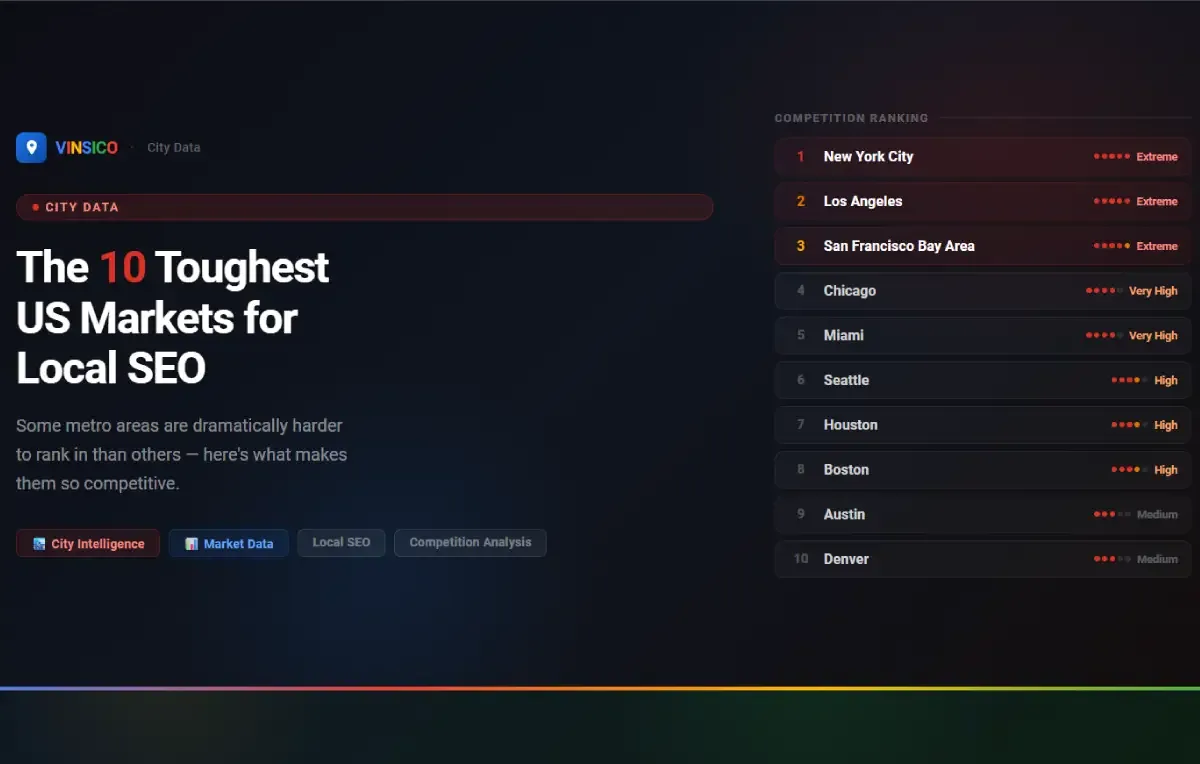
The 10 Hardest Markets
1. New York City
No surprise at the top. The sheer density of businesses per square mile means more competitors for every search query. Virtually every vertical is saturated. Legal, medical, restaurants, home services - whatever you search for, there are dozens of businesses fighting for three local pack spots. Review counts on top-ranking businesses tend to be very high because the customer volume is there to generate them.
2. Los Angeles
LA's sprawl creates multiple overlapping local markets. The auto and real estate verticals are especially tough. The challenge here isn't just competition - it's that the metro area is so spread out that proximity signals create fragmented results. A business in West Hollywood and one in Pasadena are technically in the same metro but competing in functionally different markets.
3. San Francisco Bay Area
Tech-industry influence drives optimization standards higher than average. Businesses in the Bay Area are more likely to invest in professional SEO. The restaurant scene is dense and well-reviewed. And because the population skews younger and more digitally active, review generation rates tend to be naturally higher here.
4. Chicago
Legal and healthcare are the most competitive verticals in Chicago. The city has a high concentration of professional service firms, and many of them have been investing in local SEO for years. Breaking into an established market where incumbents have hundreds or thousands of reviews takes sustained effort.
5. Miami
Bilingual optimization is more important here than in most US markets. If you're not optimizing for both English and Spanish search queries, you're leaving a big portion of the market untouched. Tourism-adjacent businesses face particularly intense competition.
6. Seattle
Similar to SF, being near a major tech hub raises the local optimization baseline. Businesses here tend to have better-completed GBP profiles than the national average, which means you need to do more to stand out.
7. Houston
Houston has been one of the fastest-growing US metros by population and business formation. That growth means new competitors are constantly entering the market. In fast-growing markets, rankings shift more frequently because the competitive landscape is always changing.
8. Boston
Academic and healthcare clusters dominate the competitive landscape. Established institutions with high domain authority and decades of citation history create a tough environment for newer businesses trying to break through.
9. Austin
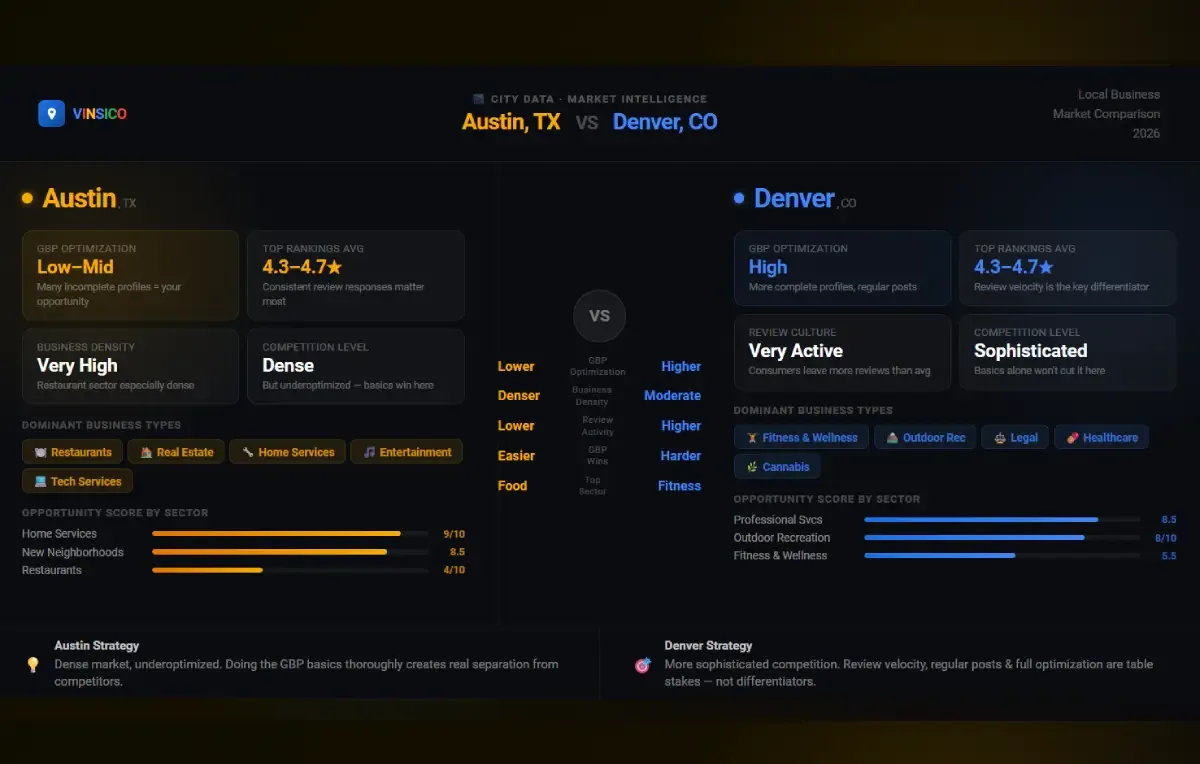
Austin's rapid tech-driven growth has made it noticeably more competitive over the last few years. Review velocity matters here - the businesses doing well in the local pack tend to be actively generating new reviews, not coasting on past ones.
10. Denver
The restaurant and outdoor recreation sectors drive a lot of local search volume. Professional services (legal, financial, consulting) face growing competition. Denver's review culture is relatively strong - consumers here leave reviews at a higher rate than many comparable markets.
What This Means for Your Strategy
If you're in one of these high-competition markets, the basics alone won't get you into the local pack. You need to be more thorough than your competitors: better-optimized profile, more reviews, more consistent citations, and stronger on-page local SEO. In a less competitive market, doing the fundamentals well can be enough to get results relatively quickly. Know your market and calibrate your expectations accordingly.