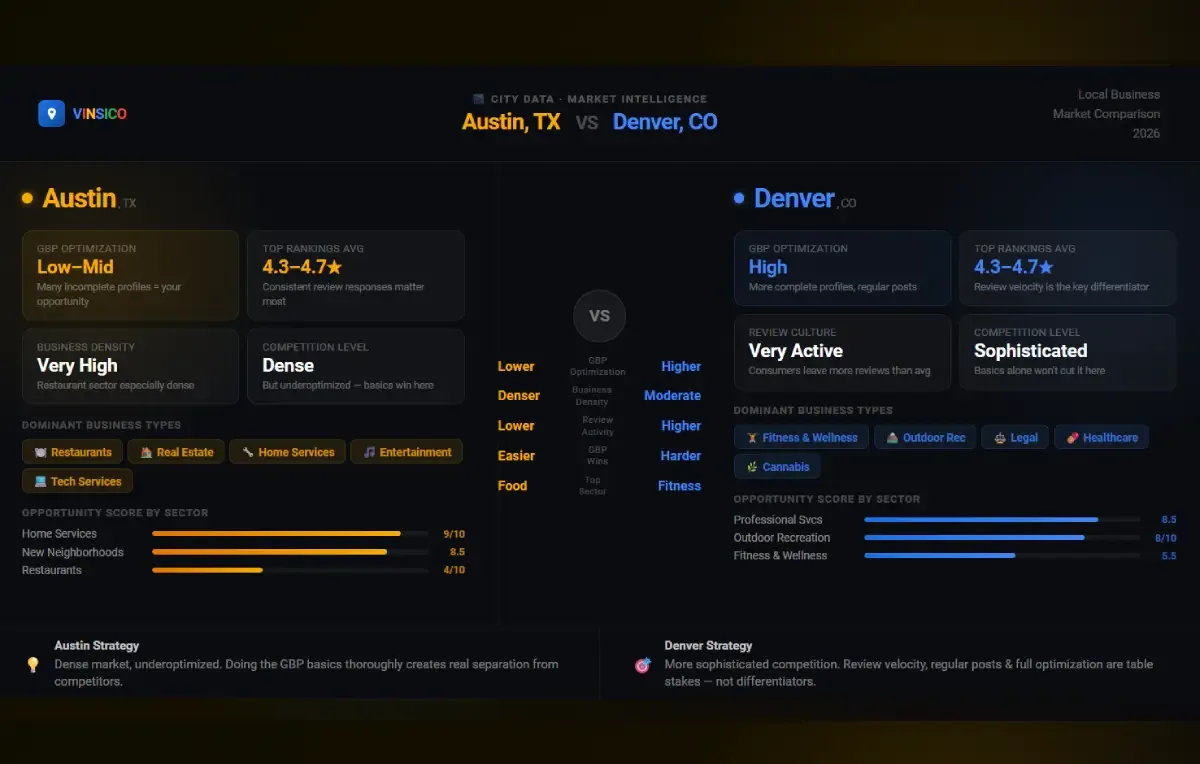
Austin and Denver get compared a lot, and it makes sense. Both are fast-growing cities with strong economies, big outdoor cultures, and food scenes people are genuinely proud of. But if you're a local business owner trying to rank on Google Maps in one of these markets, or thinking about expanding into either city, the local search landscape is different enough that it's worth understanding before you start.
This article draws on publicly available economic data, local SEO research, and observations from working across both markets. It's not a formal study, but it reflects what's actually happening on the ground right now.
The Big Picture: Two Cities at Very Different Stages
Austin is on an extraordinary growth run. It was named the fastest-growing city for small businesses in 2026 in a study by USA Business Insurance, which ranked cities based on new business applications, employment growth, commercial permits, and population trends. That's not just a headline number. New business applications in Austin are up 71% over the past several years, and the metro's GDP has surpassed $245 billion with 39% real growth from 2020 to 2025, one of the fastest rates of any major US city. Austin residents also spend more at small businesses than people in any other city in the country, averaging $627 per person per year according to a 2025 study from Nav. That's nearly $160 more than the national average.
Denver is in a different position. Colorado's economy is growing steadily, with GDP projected to rise 2.9% in 2026, outpacing the national average. But the University of Colorado's Leeds School of Business, which produces the state's most closely watched economic forecast, described the outlook as Colorado's slowest growth rate outside of a recession. Job growth in 2026 is projected at just 0.6%, and population growth has slowed considerably compared to the years when Denver was drawing massive in-migration. The city still has a strong, educated consumer base and a business community that tends to be well-organized and digitally savvy, but it's a market that's maturing rather than booming.
For a local business, this matters. Austin means more new customers entering the market every month, but also more new competitors. Denver means a more stable competitive landscape, but one where the businesses that have been around for a few years tend to be well-optimized and harder to displace.
Business Density and What It Means for Local Search Competition
Austin's restaurant sector is exceptionally dense. The city has built a national reputation around its food culture, and the number of new restaurants, food trucks, and bars opening every month is high enough that the search competition for "restaurant near me" queries in most Austin neighborhoods is intense. Real estate services are also heavily represented, driven by years of population growth and the ongoing development of surrounding suburbs like Round Rock, Georgetown, and Cedar Park.
One thing that makes Austin interesting from a local SEO perspective is that the growth is uneven across neighborhoods. Rainey Street has different search patterns from the Domain. East Austin operates in a different competitive environment than Westlake. A business in a newer development area on the outskirts of the city is often competing against far fewer established players than one trying to rank in central Austin. If you're in one of these newer growth corridors, the search opportunity is real.
Denver's competitive profile looks different. Fitness, wellness, and outdoor recreation businesses are more prominent there, reflecting how the city lives. Colorado added over 48,600 new businesses in just the first quarter of 2025, but the rate of new business formation has been normalizing after several post-pandemic years of elevated activity. The competitive map in Denver is more settled, especially in sectors like professional services, home improvement, and health and wellness, where many of the top-ranked businesses have been building their profiles for years.
Review Culture: What the Data Actually Shows
This is one of the clearest real differences between the two markets, and it's one the original version of this article underestimated.
Denver businesses tend to have higher review counts on average, particularly in the restaurant and home services categories. Part of this is cultural. The Denver consumer base has been consistently active in leaving Google reviews, and the market has had longer to accumulate them. If you're looking at the top three results for almost any service category in Denver, you're typically looking at businesses with well over 100 reviews and steady incoming velocity.
Austin's review culture is catching up fast, partly because the consumer base skews heavily toward younger, tech-savvy residents who are accustomed to checking reviews before making decisions. Research shows Austin consumers are particularly research-driven, often reading multiple reviews before choosing a business. But because so many businesses in Austin are newer, the review counts haven't had time to build the way they have in Denver. This means a business in Austin can sometimes climb into the local pack faster than it could in Denver, because the gap between new entrants and established players is smaller.
In both markets, the businesses ranking in the top three of the local pack tend to cluster in the 4.3 to 4.7 star range. A perfect 5.0 with very few reviews tends to look thin rather than impressive. What matters more is consistency: a business that's generating reviews regularly looks healthier to Google's algorithm than one that collected a burst of them at launch and then nothing since.
GBP Optimization: Where Each Market Actually Stands
This is where the two cities diverge most clearly in terms of the opportunity in front of local businesses.
Austin has a significant number of partially optimized or neglected Google Business profiles. Businesses with missing photos, outdated hours, no service descriptions, and no posting activity are common even in competitive categories. This is partly a function of growth: when new businesses are opening constantly, owners are focused on operations and not always thinking about their digital footprint. It's also partly a function of the tech industry's influence. Austin has a large community of software and startup companies that understand digital marketing well, but the same can't be said for every restaurant, home services company, or retail shop in the city.
The opportunity this creates is real. If you take the time to properly optimize your GBP in Austin, add complete service descriptions, use relevant secondary categories, keep your hours accurate, upload regular photos, and start building a review cadence, you can often stand out from competitors who are doing none of those things. The bar for "well-optimized" in many Austin verticals is lower than you'd expect.
Denver is a different story. Local businesses there have generally had longer to figure out the basics, and the average quality of GBP profiles in competitive categories is higher. More complete profiles, more consistent photo uploads, and more regular posting activity are all more common in Denver than in Austin. This means you're less likely to win in Denver just by doing the basics. You need to do them better than the people who've been doing them for years.
One documented example illustrates the Denver dynamic well: a Capitol Hill restaurant in Denver had an unclaimed profile for eight months while a competitor three blocks away dominated local search results for identical search terms. The business eventually caught up, but losing eight months of visibility in a market where competitors are already optimized is costly in a way it might not be in a younger market like Austin, where the competition may not have been that far ahead to begin with.
Where the Opportunities Are Right Now
In Austin, the clearest local search opportunities are in home services and in the city's newer outer neighborhoods. Home services like HVAC, plumbing, and electrical are high-demand categories in a city with constant new construction, and the GBP optimization levels in those categories still leave a lot of room. Areas like Cedar Park, Pflugerville, and the communities developing around the Samsung plant in Taylor are growing quickly enough that being an early, well-optimized player can establish a strong local position before competition densifies.
In Denver, the opportunity is different. It's less about finding underserved categories and more about executing consistently at a higher level than the competition. Professional services like legal, financial planning, and consulting are growing but not yet fully saturated in terms of GBP quality. Outdoor recreation and fitness businesses that can differentiate on local expertise for Colorado-specific activities have an audience that's highly engaged and willing to write detailed, content-rich reviews, which matter more than ever for rankings. And any Denver business that commits to a real review generation strategy will have an advantage in a market where the consumer base is review-active but many businesses still aren't asking systematically.
What This Means if You're Deciding Between the Two
There isn't a better market between Austin and Denver in any universal sense. It depends entirely on what you're selling and how much competition you're willing to face at different levels of sophistication.
Austin gives you a bigger and faster-growing customer base, with more room to differentiate just by doing the GBP fundamentals well. The downside is that the growth brings constant new competition, and certain categories like food and real estate are already extremely crowded in the core of the city.
Denver gives you a more stable market with a consumer base that's deeply familiar with leaving reviews and researching businesses online. The downside is that the businesses you're competing against have often been building their local search presence for longer, and the optimization gap you can exploit in Austin is narrower there.
The honest answer for any local business is this: study your specific category in your specific target area before drawing conclusions from city-level comparisons. Pull up Google Maps, search for what you do, and look at how many reviews the top three results have, how recently they've been posted, and how complete those profiles look. That ten-minute exercise will tell you more about your actual competitive situation than any general market comparison.