
Most business owners know reviews matter. But knowing reviews matter and actually having a plan to get them are two very different things. This article is about the second part. Not the why, but the how, and more importantly, what the latest data tells us about what's actually working right now.
Why New Reviews Matter More Than Your Overall Rating
Here's something a lot of business owners get wrong. They assume that once they have a solid rating and a decent number of reviews, they're in good shape. The reality is a bit different.
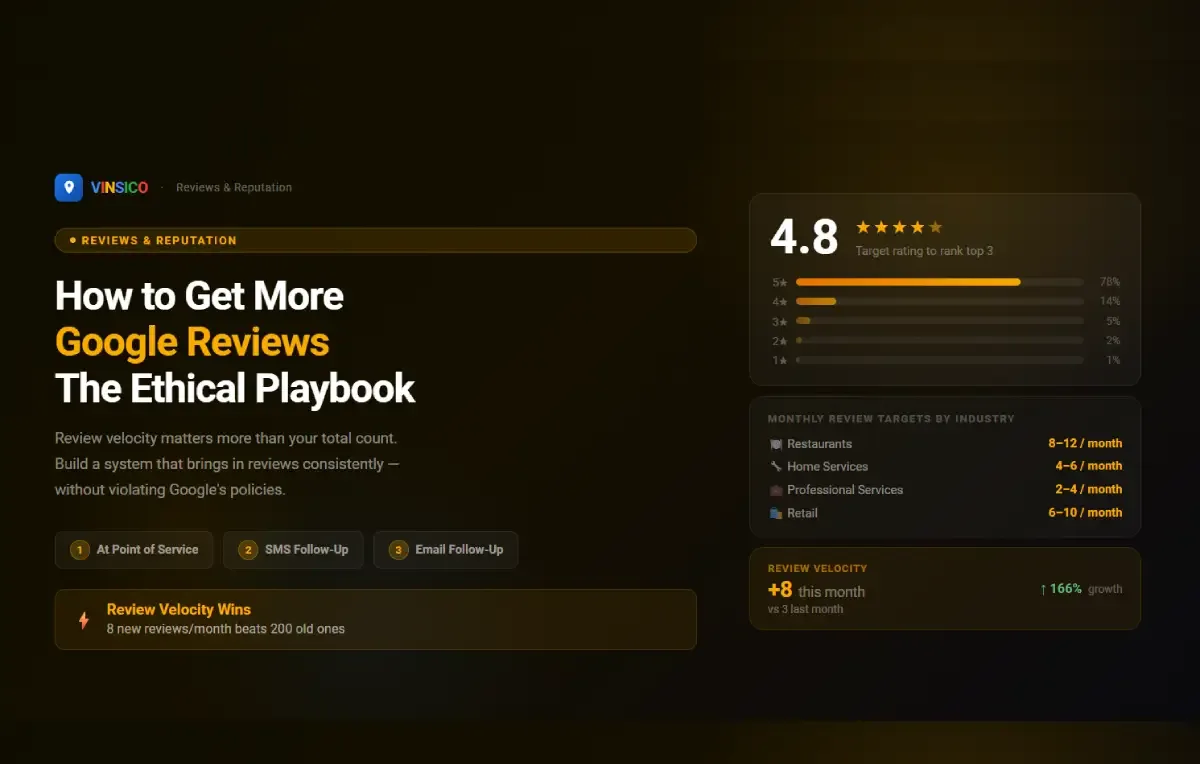
Review velocity, meaning how consistently you're earning new reviews, matters more for rankings than your total count. The 2026 Whitespark Local Search Ranking Factors survey confirmed that review signals now account for roughly 20% of local pack rankings, up from 16% in 2023. That's a significant increase in just a couple of years.
And within that, recency is the key factor. Research shows that reviews from the past 90 days carry significantly more algorithmic weight than older ones. A business sitting on 300 reviews from two years ago, with nothing new coming in, is going to be outpaced by a competitor who's generating a steady 5 or 6 reviews every month. Google uses fresh reviews as evidence that a business is currently active and currently serving customers well.
The other thing that's changed: the star rating threshold has moved up sharply. According to BrightLocal's 2026 consumer survey, 31% of consumers say they will only use a business rated 4.5 stars or higher. That's up from just 17% the year before. And 68% won't consider a business below 4 stars, compared to 55% in 2025. Consumer expectations around ratings have jumped faster in the past year than in the several years before that combined.
So yes, your star rating still matters. But a great rating with stale, infrequent reviews is no longer enough. You need both.
Don't Rely on Google Alone Anymore
One more thing worth knowing before we get into tactics. Google is still by far the most important review platform for local rankings. But its share of consumer review reading has actually dropped, from 83% in 2025 to 71% in 2026, according to BrightLocal's research. Consumers are now using an average of six different review platforms when they're researching a business.
Apple Maps nearly doubled in usage over the past year. Facebook, Tripadvisor, and Yelp all saw increased engagement. And this is the one that surprises most people: the use of ChatGPT and similar AI tools for local business recommendations jumped from 6% to 45% in just one year. Nearly half of consumers are now asking AI tools where to go or who to hire. Those tools pull from reviews too.
The point is this: building your review presence on Google is the priority, but it shouldn't be the only place you're focused on.
The 3-Touch System for Getting Reviews Consistently
The businesses that do this well don't rely on memory or occasional reminders. They have a repeatable process. Here's a simple one that works.
Touch 1: Ask In Person Right After the Job
The best moment to ask for a review is when the customer is happiest, which is right after you've delivered a good experience. That's it. Don't overthink the wording. Something like "If you're happy with the work, a Google review would mean a lot to us" is genuinely all you need to say.
Have your review link ready to send. You can generate a direct review link from your Google Business Profile dashboard by searching for your business, clicking "Ask for reviews," and copying the link. Turn that into a QR code and put it on a card, a receipt, or an invoice. Make it as easy as possible for them to follow through in the next few minutes.
Touch 2: A Text Message Within a Few Hours
Text messages have much higher open rates than emails, and most people read them within minutes. Send a short, personal follow-up the same day. Mention the specific service you did, keep it warm and brief, and include the direct link.
Something like: "Hi Sarah, thanks for choosing us for your kitchen repair today! If you have a moment, a quick Google review really helps us out." Then the link. That's all it needs to be. No paragraphs, no over-explaining.
This is usually the highest-converting step in the whole process. Most reviews come from this one touch.
Touch 3: A Follow-Up Email Within 48 Hours
If they didn't act on the text, a follow-up email the next day or the day after catches a different group of people. Some customers prefer email, some just missed your text, and some need that second nudge before they get around to it.
For home service businesses especially, including a before and after photo of the work in the email is a nice touch. It reminds them of the job, shows the quality, and gives them a natural reason to want to talk about it. Close the email with the review link and a single clear ask.
One thing to avoid: sending review requests in bulk every few months. A burst of 20 reviews in one week followed by nothing for three months is exactly the wrong pattern. Google's algorithm rewards steady, consistent velocity. Bursts look unnatural and the ranking benefit fades fast. Build it into your regular routine instead.
How to Handle Negative Reviews
Negative reviews happen to every business eventually. The way you respond to them matters more than most people realize.
When someone leaves a bad review, potential customers reading it aren't just reading the complaint. They're reading your response. A thoughtful, professional reply often leaves a better impression than if the negative review hadn't existed at all. BrightLocal's consumer research has consistently found that a business responding well to criticism increases trust rather than reducing it.
A good response does four things: it acknowledges the issue, it expresses genuine empathy without being defensive, it offers to resolve things offline, and it keeps the tone calm and professional throughout. You're not writing the response for the person who left the review. You're writing it for every future customer who reads it.
Try to respond within 24 hours. Leaving a negative review sitting without a response for a week sends its own message.
Also worth knowing: even negative reviews, when handled well, generate engagement on your profile, and engagement is a ranking signal. A bad review isn't just damage control. Done right, it's an opportunity.
How Many Reviews Should You Be Aiming For Each Month?
There's no single right answer. It depends on your industry, your market size, and most importantly, what your closest competitors are generating. That last one is the benchmark that actually matters.
That said, here are rough targets based on typical industry volumes:
- Restaurants and cafes: 8 to 12 per month. High customer volume makes this achievable if you have a system in place.
- Home services (plumbers, electricians, HVAC, cleaners): 4 to 6 per month. Research suggests this range, maintained consistently, is enough to outrank competitors with higher totals but irregular patterns.
- Professional services (legal, accounting, financial): 2 to 4 per month. Lower client volume means every review matters more.
- Retail: 6 to 10 per month, depending on foot traffic.
But again, check what your top-ranked local competitors are actually generating. If the business ranking above you is getting 3 new reviews a month, matching and slightly exceeding that consistently is your real target. Don't aim at a generic number. Aim at the competition in your specific area.
What About Review Content? Does It Matter What People Write?
Yes, more than it used to. Google is now reading and processing the actual text of reviews, not just counting stars. Reviews that mention specific services, locations, or detailed descriptions of the experience carry more algorithmic weight than short, generic ones like "Great service, highly recommend."
You can't tell customers what to write, and you shouldn't try. But you can ask questions that naturally lead to more detailed responses. When you ask someone for a review, a slight variation like "If you could mention what we did and how it went, that really helps" tends to produce more specific content without feeling like coaching.
Detailed reviews also help with AI-generated search results. When ChatGPT or Google AI Overviews recommend a local business, they're often pulling context from review language. Reviews with specific, relevant details make your business easier for those systems to understand and recommend.
Tools That Can Help
You don't need to spend money to start. Google's built-in review link generator is free and sufficient for most small businesses. If you want to automate the follow-up process or manage reviews across multiple locations, there are paid tools worth looking at. GatherUp and Podium both handle automated review request sequences. BrightLocal is useful if you want monitoring dashboards and multi-platform tracking. Whitespark's Reputation Builder does similar things on their platform.
For most single-location businesses, though, the free approach works fine. A review link, a QR code, and the habit of asking consistently will outperform any tool if you don't have the process in place first.
The Short Version
Get reviews consistently, not in bursts. Respond to every review, good and bad. Aim for the 4.5 star mark and keep it there. And stop treating Google as your only focus. Consumers are spreading their research across more platforms than ever, and showing up well across all of them is what separates the businesses that grow from the ones that plateau.
None of this is complicated. It just requires actually doing it on a regular basis, which is where most businesses fall short.
.webp)